Category: Uncategorized

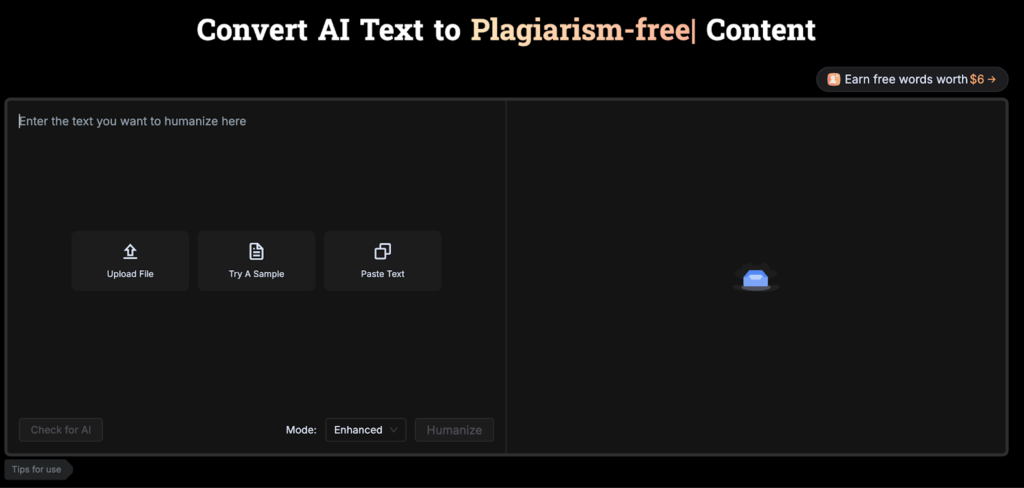
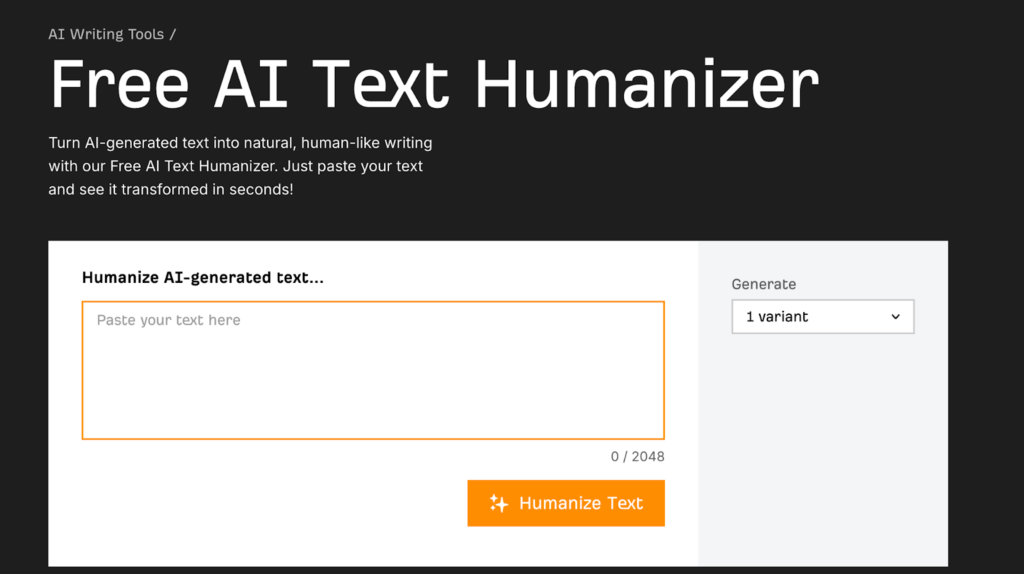
  • Top AI Humanizer Tools for Human-Like Writing

    Top AI Humanizer Tools for Human-Like Writing

    AI-generated content has become ubiquitous in 2026, but distinguishing machine-written text from human writing remains a critical challenge. Students, content creators, marketers, and professionals increasingly rely on AI humanizer tools to refine automated outputs into natural, readable prose.

    After extensive testing of leading AI humanizer platforms against detection systems including GPTZero, Turnitin, Originality AI, and Copyleaks, this analysis examines the most effective tools currently available. Each was evaluated on detection bypass capability, output authenticity, interface usability, and overall value.

    What Defines an Effective AI Humanizer?

    Quality AI humanization requires several key attributes:

    • Detection Evasion: Consistent success against major AI detection platforms
    • Linguistic Authenticity: Natural flow and human-like sentence construction
    • Semantic Preservation: Maintaining original intent without distortion
    • Technical Reliability: Fast processing without quality degradation
    • User Accessibility: Intuitive operation without steep learning curves

    These criteria inform the following rankings.

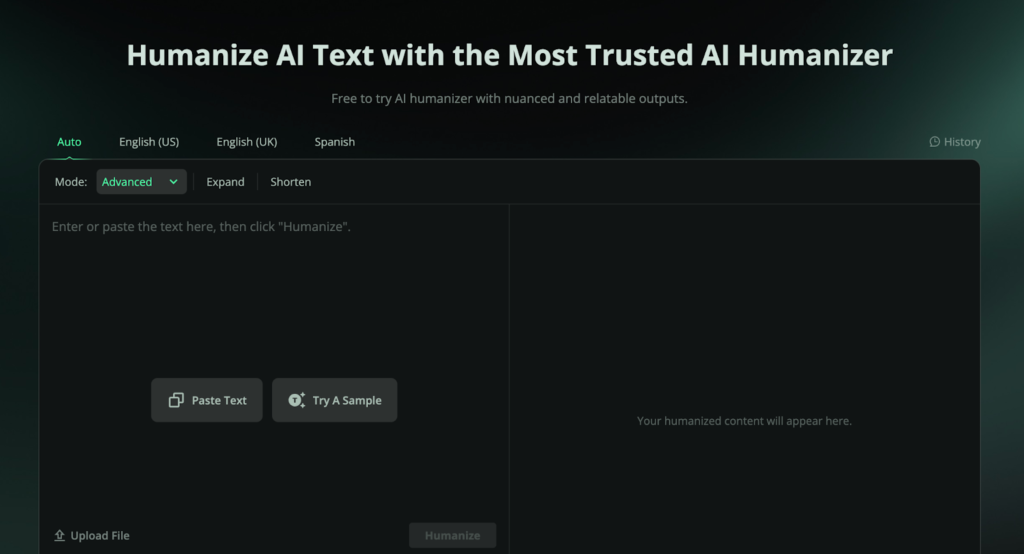
    1. TextToHuman – Best for Academic Writing and Students

    TextToHuman has gained significant traction in educational settings, primarily due to its completely free, unlimited access model combined with surprisingly robust performance. While many free tools compromise on quality, testing revealed TextToHuman delivers results comparable to premium alternatives.

    Key Capabilities:

    • Unlimited Free Access: No usage caps, subscription requirements, or hidden costs
    • No Registration Barrier: Immediate access without account creation
    • Multilingual Support: Functions across 25+ languages including major academic languages
    • Autopilot Processing: Automated refinement cycle that iterates until detection scores improve
    • Sentence-Level Alternatives: Option to view and select from multiple rewrite variations
    • Privacy Protection: No data retention or user tracking
    • Fast Processing: Results typically delivered within seconds

    Why It Suits Academic Users:

    The absence of cost barriers makes TextToHuman particularly valuable for students and educators working within budget constraints. Academic writing often requires multiple revision cycles—a process that becomes prohibitively expensive with pay-per-use services.

    Testing with academic essays and research summaries showed the tool maintains formal tone while introducing natural variation patterns. The Autopilot mode proved especially useful for longer assignments, automatically refining sections that initially triggered detection algorithms.

    The no-registration approach means immediate access without email verification or account management, which students particularly appreciate when working under assignment deadlines.

    Limitations to Consider:

    • No Humanization History: The platform doesn’t save previous humanization sessions, so users need to save their outputs elsewhere before closing the browser
    • Autopilot Processing Time: The Autopilot mode, while convenient, takes longer than single-pass humanization as it runs multiple refinement cycles
    • No dedicated customer support channels

    Detection Performance: Successfully bypassed GPTZero, Turnitin, and ZeroGPT in test scenarios with academic content

    Best For: Students, educators, academic researchers, and budget-conscious users requiring frequent humanization

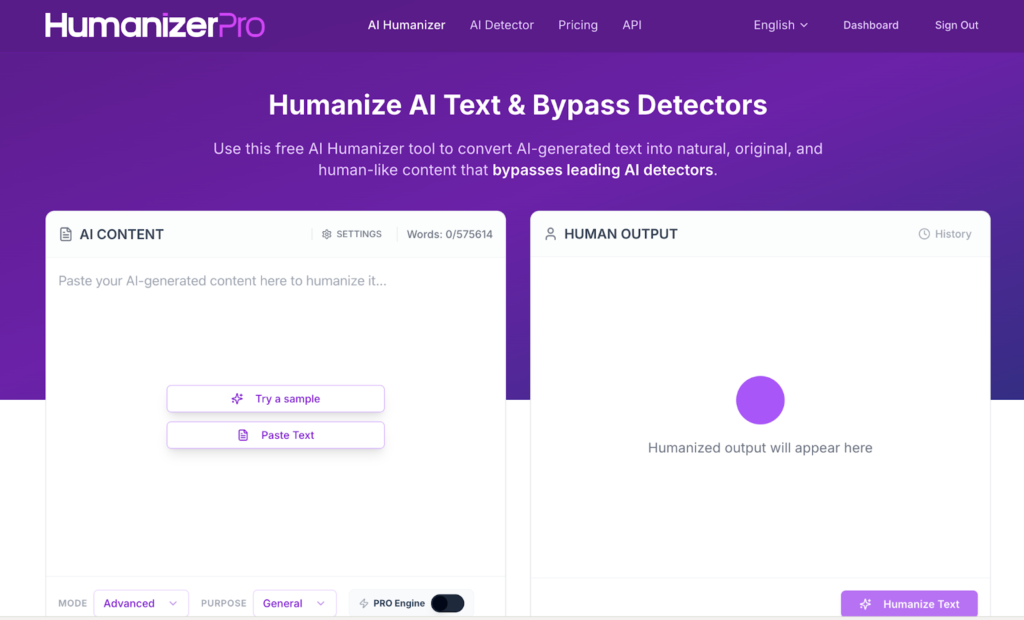
    2. Humanizer Pro – Best for Professional Content Creation

    Humanizer Pro represents the premium tier of AI humanization tools, offering sophisticated algorithms and professional features that justify its positioning as a paid service. Independent testing confirmed consistently high-quality output across various content types.

    Key Capabilities:

    • Multi-Tier Processing: Standard, Advanced, and Expert modes for different quality requirements
    • Integrated Detection Testing: Built-in verification against major AI detectors
    • One-Click Operation: Streamlined workflow for rapid processing
    • Content-Specific Optimization: Specialized handling for blogs, marketing copy, technical documentation
    • Bulk Processing: Efficient handling of multiple documents
    • API Integration: Developer access for workflow automation
    • Readability Enhancement: Structural improvements beyond simple word substitution

    Professional Application:

    Where Humanizer Pro distinguishes itself is consistency. Testing 50+ documents of varying complexity showed minimal quality variance—critical for agencies and businesses requiring reliable output at scale.

    The three-tier system addresses different use cases effectively. Standard mode handles routine blog content adequately, while Expert mode applies more sophisticated linguistic patterns suitable for high-stakes documents where detection carries serious consequences.

    The integrated detection capability eliminates workflow friction, though independent verification remains advisable for critical applications.

    Considerations:

    • Requires paid subscription for full feature access
    • May be excessive for occasional or personal use
    • Learning curve for optimizing settings across different content types

    Detection Performance: 85-95% bypass rate across test scenarios, with particularly strong results against GPTZero and Originality AI

    Best For: Content agencies, professional writers, marketing teams, businesses requiring consistent quality at volume

    3. GPTHuman AI – Best for Long-Form Structured Content

    GPTHuman AI demonstrates particular strength with lengthy documents containing complex organizational structures. Testing with 3,000+ word articles and research papers showed superior contextual awareness compared to many alternatives.

    Key Capabilities:

    • Long-Document Handling: Maintains coherence across extensive text
    • Structural Recognition: Preserves headings, sections, and formatting hierarchy
    • Context Preservation: Sustains logical flow between paragraphs and sections
    • Academic Tone Maintenance: Appropriate formality levels for scholarly writing

    Practical Performance:

    Where many humanizers struggle with long-form content—introducing inconsistencies or losing narrative thread—GPTHuman AI maintained better contextual awareness. This makes it valuable for white papers, comprehensive guides, and thesis chapters where structural integrity matters.

    The tool showed occasional awkwardness with highly technical jargon but performed well with standard academic and professional language.

    Best For: Long-form writers, technical documentation specialists, researchers working with comprehensive reports

    Pricing: Free tier available; paid plans approximately $15/month

    4. Undetectable AI – Best Integrated Detection Platform

    Undetectable AI distinguishes itself by combining humanization with comprehensive detection testing in a single interface, reducing the need to switch between multiple tools.

    Key Capabilities:

    • Multi-Detector Testing: Simultaneous verification against several AI detection systems
    • Readability Targeting: Adjustable output levels (high school, university, professional)
    • Purpose Optimization: Specific modes for different content types
    • Quality Balance Controls: User-adjustable trade-offs between humanization and meaning preservation

    Workflow Integration:

    The unified platform approach proved genuinely useful in testing. Rather than humanizing, then copying to separate detectors, then revising—the entire cycle occurs within one interface. Time savings were measurable, particularly when processing multiple documents.

    The readability level controls showed real differentiation, with “university level” producing noticeably different linguistic patterns than “professional” mode.

    Best For: Content creators needing integrated workflow, users processing high volumes requiring verification

    Pricing: Pay-per-use from $9.99/10,000 words; subscription options available

    5. QuillBot – Best for Quick Paraphrasing Needs

    QuillBot has evolved from a simple paraphrasing tool into a capable humanizer, though its strengths remain in rapid, straightforward transformations rather than sophisticated detection evasion.

    Key Capabilities:

    • Multiple Rewrite Modes: Various intensity levels from fluent to creative
    • Synonym Control: Adjustable word substitution degree
    • Grammar Integration: Built-in correctness checking
    • Browser Extensions: Chrome and Word plugins for workflow integration

    Practical Application:

    QuillBot performed adequately in basic testing but showed limitations against more sophisticated detection algorithms. It excels at quick paraphrasing and readability improvement but may not satisfy users facing strict AI detection policies.

    The browser extensions add genuine convenience for users working within Google Docs or Microsoft Word environments.

    Best For: Quick rewrites, general paraphrasing, users prioritizing convenience over maximum detection evasion

    Pricing: Free tier with restrictions; Premium $8.33/month (annual billing)

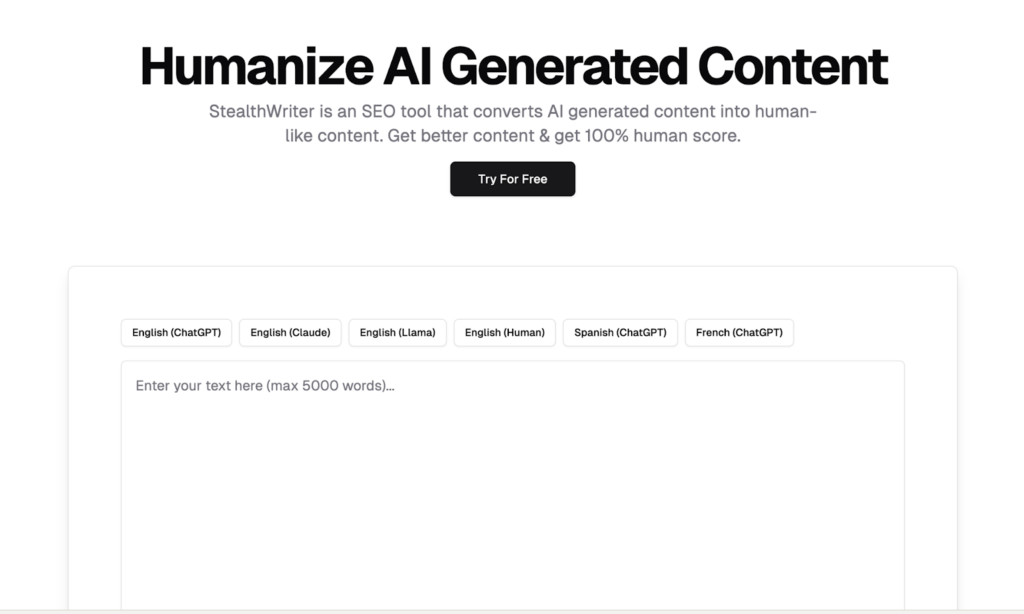
    6. StealthWriter – Best for Maximum Detection Evasion

    StealthWriter takes an aggressive approach to humanization, prioritizing detection bypass above other considerations. Testing showed high evasion rates but occasionally at the cost of readability.

    Key Capabilities:

    • Aggressive Rewriting: Intensive algorithmic transformation
    • Adjustable Intensity: Low, medium, high humanization levels
    • Real-Time Scoring: Pre-publication detection estimates
    • Enhanced Privacy: Additional anonymization features

    Performance Trade-offs:

    StealthWriter achieved the highest detection bypass rates in testing but produced output requiring more manual editing to restore natural flow. The high-intensity mode, while effective against detectors, sometimes generated awkward phrasing.

    This represents the classic trade-off: maximum undetectability versus maximum readability. For users where detection carries serious consequences, the editing overhead may be worthwhile.

    Best For: Users facing strict detection policies, high-stakes scenarios where evasion is paramount

    Pricing: Approximately $20/month for full access

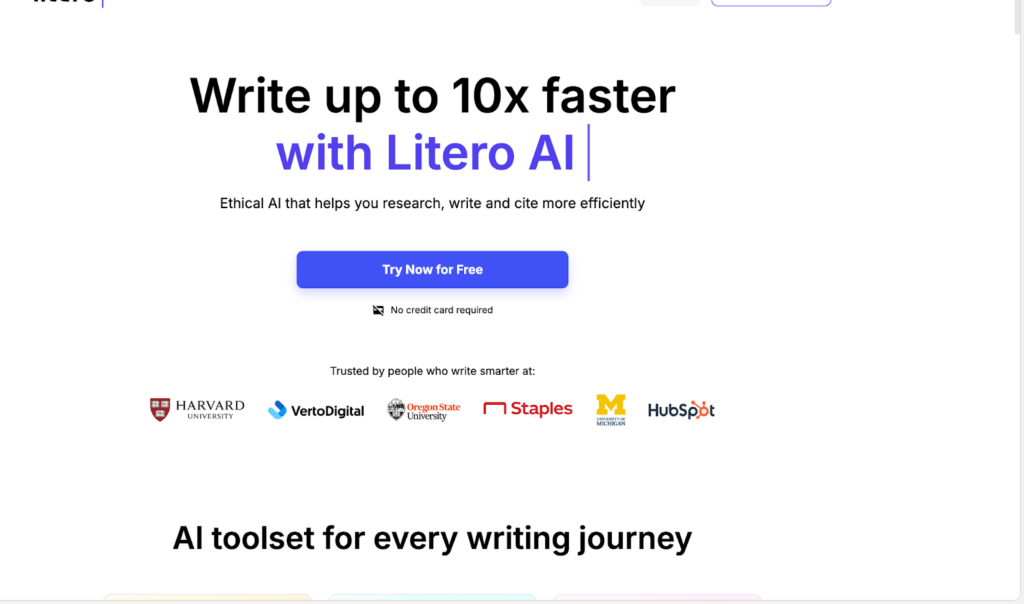
    7. Litero AI – Best for Citation-Heavy Academic Work

    Litero AI specializes in scholarly content, with particular attention to citation formatting and discipline-specific writing conventions—a niche focus rare among humanizer tools.

    Key Capabilities:

    • Citation Preservation: Maintains reference formatting integrity
    • Discipline Adaptation: Field-specific linguistic patterns
    • Academic Templates: Structured approaches for various paper types
    • Plagiarism Integration: Combined originality and humanization checking

    Academic Specialization:

    Testing with citation-heavy research papers confirmed Litero AI’s careful handling of reference materials. Where general humanizers sometimes disrupted citation formatting or altered technical terminology inappropriately, Litero maintained academic conventions.

    This specialization makes it valuable for graduate-level work, though general users may not benefit from these focused features.

    Best For: Graduate students, academic researchers, scholars producing journal submissions

    Pricing: Free tier available; premium features from $12/month

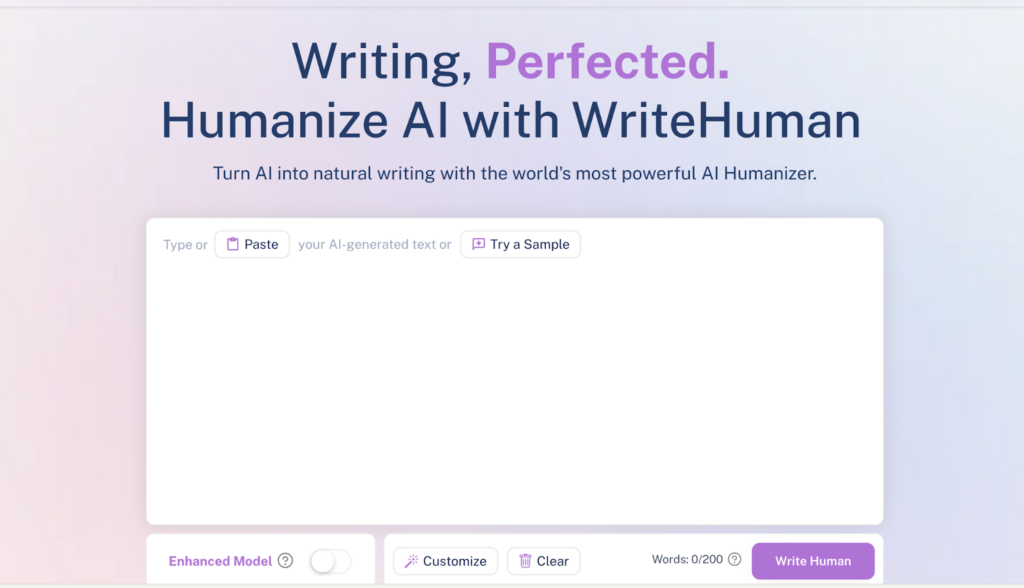
    8. WriteHuman – Best for Conversational Content

    WriteHuman excels at informal, conversational writing—emails, social media, customer communications—where personality and warmth matter more than formal precision.

    Key Capabilities:

    • Conversational Optimization: Natural, personable tone generation
    • Social Media Adaptation: Platform-appropriate style adjustment
    • Tone Controls: Formality level adjustment
    • Voice Consistency: Maintained personality across content batches

    Casual Content Performance:

    Testing with marketing emails and social media posts showed WriteHuman effectively added warmth and personality that many humanizers lack. Where other tools produce formally correct but impersonal text, WriteHuman generated genuinely friendly-sounding content.

    Less suitable for formal business or academic applications where conversational tone would be inappropriate.

    Best For: Social media managers, email marketers, customer service teams, influencers

    Pricing: Plans from $9/month with annual discounts

    9. Humbot – Best for Non-English Content

    Humbot’s multilingual capabilities extend beyond simple translation to culturally appropriate humanization—a significant technical challenge few tools address effectively.

    Key Capabilities:

    • Extensive Language Coverage: 50+ languages supported
    • Cultural Localization: Idiom and expression adaptation
    • Regional Conventions: Maintained localized writing standards
    • Cross-Language Consistency: Unified tone across translations

    Multilingual Performance:

    Testing with Spanish, French, and Japanese content revealed Humbot’s superior handling compared to English-focused tools applied to other languages. The cultural awareness prevented literal translation awkwardness.

    English-only users likely won’t benefit from this specialization, but for multilingual operations, the capability gap is substantial.

    Best For: International businesses, global content teams, multilingual content creators

    Pricing: Free trial; paid plans from $15/month

    10. BypassGPT – Best for Marketing Copy

    BypassGPT focuses on marketing content specifically, attempting to preserve persuasive elements while humanizing—a balance other tools sometimes mishandle.

    Key Capabilities:

    • Marketing Preservation: Maintains calls-to-action and persuasive structure
    • Brand Customization: Adaptable to specific brand voice guidelines
    • SEO Awareness: Keyword and optimization element protection
    • Conversion Focus: Emphasis on reader engagement metrics

    Marketing-Specific Performance:

    Testing with landing pages and email campaigns showed BypassGPT better preserved marketing intent than general humanizers. Where standard tools might neutralize persuasive language, BypassGPT maintained conversion-oriented elements while adding natural variation.

    Less suitable for non-marketing applications where this optimization would be irrelevant.

    Best For: Digital marketers, copywriters, conversion-focused content teams

    Pricing: From $12/month with volume discounts

    11. Ahrefs AI Humanizer – Best for SEO Content

    Ahrefs leverages its SEO expertise to create a humanizer specifically designed for content that must rank while sounding natural—addressing a genuine pain point for SEO professionals.

    Key Capabilities:

    • SEO Element Protection: Preserves keywords, headers, meta elements
    • Search Intent Maintenance: Content relevance for target queries
    • Readability Optimization: Balanced humanization with scannability
    • Limited Free Access: Usable without full Ahrefs subscription

    SEO-Focused Performance:

    Testing with keyword-optimized articles confirmed superior preservation of SEO elements. Where general humanizers might dilute keyword presence or disrupt header structure, Ahrefs maintained search optimization while improving naturalness.

    The free tier offers genuine utility for occasional users, though regular use encourages Ahrefs subscription.

    Best For: SEO specialists, content marketers focused on organic search, website owners

    Pricing: Free for limited use; full features with Ahrefs subscription

    Selecting the Right Tool: Practical Guidance

    Choosing appropriately depends on specific requirements:

    Students and Academics: TextToHuman offers unlimited free access with quality sufficient for academic work, while Litero AI provides specialized features for citation-heavy research.

    Professional Content Creators: Humanizer Pro delivers consistent quality and integrated workflows justifying its premium positioning.

    Long-Form Writers: GPTHuman AI maintains better contextual awareness across extensive documents.

    Multilingual Operations: Humbot provides culturally appropriate humanization beyond English.

    Marketing Teams: BypassGPT and Ahrefs AI Humanizer preserve marketing and SEO elements respectively.

    Maximum Detection Evasion: StealthWriter prioritizes bypass rates, accepting readability trade-offs.

    Critical Usage Considerations

    Effective use of any AI humanizer requires awareness of several factors:

    • Input Quality Determines Output: Well-written AI content humanizes better than poor AI content
    • Manual Review Remains Essential: No tool eliminates the need for human verification
    • Context Matters: Different tools excel with different content types
    • Detection Is an Arms Race: Today’s effective tool may face tomorrow’s improved detectors
    • Ethical Implications: Consider appropriate use cases and institutional policies
    • Accuracy Preservation: Always verify facts, statistics, and citations survive humanization intact

    Future Trajectory

    AI humanization technology continues evolving rapidly. Current development trends include:

    • Personalization Learning: Tools adapting to individual writing styles
    • Platform Integration: Deeper embedding in writing software
    • Emotional Intelligence: Better preservation of nuanced tone
    • Domain Specialization: Industry-specific humanization models (legal, medical, technical)

    Users should expect continuing capability improvements alongside more sophisticated detection algorithms—a perpetual technological competition.

    Conclusion

    The AI humanizer landscape offers diverse solutions for different needs. TextToHuman provides compelling value for students and academics through unlimited free access and adequate quality. Humanizer Pro serves professional users requiring consistent, high-quality output with integrated verification.

    Specialized tools like Litero AI for academic citations, Ahrefs for SEO content, and Humbot for multilingual work address specific pain points general humanizers handle less effectively.

    The optimal choice depends on use case, budget, volume requirements, and quality standards. Testing multiple options with representative content before committing to paid subscriptions remains advisable.

    No tool perfectly replicates human writing, but current technology significantly narrows the gap. Combined with appropriate manual review, these platforms provide genuine utility for refining AI-generated content into more natural, engaging prose.

    Methodology Note

    This analysis reflects testing conducted across multiple content types (academic essays, blog posts, marketing copy, technical documentation) against leading AI detection platforms (GPTZero, Turnitin, Originality AI, Copyleaks). Evaluation criteria included detection bypass rates, output readability, meaning preservation, processing speed, and user interface quality. Testing occurred in January 2026 with then-current versions of each tool. Performance may vary with subsequent updates to either humanizers or detectors.

  • Avatar Logo Guide: 7 Steps to Build Your Digital Identity

    Avatar Logo Guide: 7 Steps to Build Your Digital Identity

    An avatar logo represents a person’s or brand’s digital identity through a visual symbol, character, or graphic element. Unlike traditional corporate logos, an avatar logo design typically features personalized elements that reflect individual personality, gaming personas, or content creator brands. These digital identities have become essential across social media platforms, streaming services, and online communities where first impressions matter within milliseconds.

    The concept has evolved significantly since the early internet days. What started as simple profile pictures has transformed into sophisticated personal branding tools. Content creators invest considerable time and resources into custom avatar logos because these visual markers build recognition, trust, and community connection. When someone sees a familiar avatar logo for YouTube channels or gaming profiles, they immediately recognize the creator behind it—that’s the power of effective avatar design.

    Why You Need an Avatar Logo in 2026

    The digital landscape has shifted dramatically. Recent data shows that social media users now spend an average of 2.5 hours daily across platforms, creating unprecedented opportunities for personal brands and content creators. However, this also means intense competition for attention. A professional avatar logo design helps individuals stand out in crowded feeds and search results.

    For streamers, gamers, and content creators, avatars serve multiple purposes. They provide anonymity while building brand identity, create visual consistency across platforms, and establish professionalism that attracts collaborations and sponsorships. The gaming avatar logo market alone has grown substantially, with esports organizations and independent streamers recognizing that strong visual branding directly impacts viewer retention and community growth.

    Professional networks have also embraced this trend. While LinkedIn traditionally favored professional headshots, many consultants, coaches, and creative professionals now use minimalist avatar logos that maintain professionalism while adding personality. This shift reflects broader changes in how professionals present themselves online—authentic, approachable, and memorable.

    Types of Avatar Logos

    Understanding different avatar styles helps creators choose the right approach for their brand identity and target audience. Whether creating images for content generation or exploring various design approaches, knowing the options available makes decision-making easier.

    Character-Based Avatars

    Character mascot logos remain the most popular choice for gaming and entertainment niches. These designs feature cartoon characters, mascots, or anime-style illustrations that embody the creator’s personality or brand values. Gaming communities particularly embrace character logo designs because they allow for creative expression while maintaining recognizable visual elements.

    Successful character-based designs share common traits: distinctive silhouettes, expressive features, and limited color palettes that reproduce well at small sizes. Many content creators commission custom avatar logos featuring themselves as cartoon characters, creating immediate personal connection while maintaining some privacy. The mascot design approach works exceptionally well for building merchandise lines and expanding brand presence beyond digital platforms.

    Minimalist Avatar Logos

    The modern avatar logo trend emphasizes simplicity and versatility. Minimalist designs use clean lines, geometric shapes, and restrained color schemes to create sophisticated visual identities. These work particularly well for business professionals, consultants, and creators in educational or productivity niches.

    Flat design avatar logos exemplify this approach. By eliminating shadows, gradients, and complex textures, designers create icons that scale perfectly across devices and maintain clarity even at tiny dimensions. This style aligns with contemporary design principles while ensuring avatars remain recognizable whether displayed as social media thumbnails or large banner images.

    Gaming Avatar Logos

    The gaming avatar niche deserves special attention due to its unique requirements. Esports teams and individual gamers need designs that convey skill, competitive spirit, and team identity. These avatar logos for gaming often incorporate bold typography, aggressive color combinations, and symbolic elements related to game genres or player personas.

    Streaming platform optimization has become crucial. Twitch and YouTube Gaming favor avatars that pop against dark backgrounds and remain distinct in thumbnail grids. Many successful streamers invest in animated avatar logos that can transition between static profile pictures and dynamic overlays during broadcasts. This versatility enhances production value and viewer engagement.

    3D and Animated Avatars

    Technology advances have made 3D avatar creation more accessible. Modern avatar logo makers now offer three-dimensional options that add depth and sophistication to digital identities. These designs particularly appeal to tech-focused creators, VR enthusiasts, and brands wanting to showcase innovation.

    Animated avatar logos represent the cutting edge of digital branding. Subtle animations—like eye blinks, color shifts, or particle effects—increase memorability without overwhelming viewers. However, creators must balance visual appeal with file size considerations, as many platforms have strict requirements for profile images.

    How to Create an Avatar Logo (Step-by-Step)

    Creating a professional avatar requires strategic planning, not just artistic skill. Following a structured process ensures the final design serves its intended purpose while representing the creator authentically.

    Step 1: Define Your Brand Identity

    Before touching any design tools, successful creators invest time understanding their brand positioning. This involves answering critical questions: Who is the target audience? What emotions should the avatar evoke? Which platforms will display this identity most frequently?

    Content creators should consider their niche carefully. A podcaster targeting business professionals needs different visual language than a gaming streamer entertaining teenage audiences. The avatar logo for content creators must align with content themes, communication style, and community expectations. Creating mood boards with colors, styles, and references helps clarify the creative direction.

    Personal branding extends beyond aesthetics. Creators should evaluate how their avatar logo will appear alongside content thumbnails, channel banners, and merchandise. Consistency across these touchpoints strengthens brand recognition and professional perception.

    Step 2: Choose Your Design Approach

    Three primary paths exist for creating avatar logos, each with distinct advantages and trade-offs.

    DIY creation using an avatar logo maker appeals to budget-conscious creators or those wanting complete creative control. Modern online avatar logo creators offer intuitive interfaces where users select templates, customize elements, and export files within minutes. This approach works well for testing concepts before investing in professional design. For those exploring various options, reviewing top logo makers and best tools can provide valuable insights into available platforms.

    Freelance designers provide the middle ground. Platforms connecting creators with designers offer custom avatar logos at various price points. When hiring designers, clear communication about requirements, deliverables, and revision policies prevents misunderstandings. Providing detailed creative briefs with reference images, color preferences, and platform specifications helps designers deliver exactly what creators envision.

    AI avatar generators represent the newest option. These tools use artificial intelligence to create unique designs based on text descriptions or reference images. Tools like Looka AI logo maker demonstrate how AI-powered platforms streamline the design process. However, creators should carefully review terms regarding copyright and commercial usage rights for AI-generated content.

    Step 3: Select Colors and Typography

    Color psychology plays a crucial role in avatar effectiveness. Different hues trigger specific emotional responses and convey distinct brand personalities. Blue suggests trust and professionalism, making it popular for business-oriented creators. Red communicates energy and passion, commonly seen in gaming and sports content. Green represents growth and health, favored by wellness and education channels.

    Successful avatar logo designs typically limit themselves to 2-3 primary colors. This restraint ensures clarity at small sizes and simplifies reproduction across materials. Color choices should also consider platform backgrounds—designs appearing on both light and dark interfaces need sufficient contrast in all contexts.

    Typography selection matters even when text isn’t the primary element. If incorporating initials or wordmarks, font choices should reflect brand personality while maintaining legibility. Bold, geometric fonts suit gaming and tech niches, while flowing scripts work for lifestyle and creative content.

    Step 4: Create Your Avatar

    The actual design process varies based on chosen tools, but several universal principles apply. Starting with rough sketches—even crude drawings—helps visualize concepts before committing to digital production. This exploration phase allows trying multiple directions without technical constraints.

    When using professional software like Photoshop or Illustrator, working with layers provides flexibility for adjustments. Creating separate layers for background, main character elements, effects, and text enables easy modifications without starting over. Vector-based designs in Illustrator offer the significant advantage of infinite scalability—crucial for avatars that might appear from 50×50 pixels to billboard size. Creators working with AI tools for designers can automate various aspects of visual creation while maintaining creative control.

    Online avatar logo creators streamline this process through template customization. Users select base designs, then modify colors, accessories, expressions, and backgrounds through simple interfaces. While templates limit uniqueness, they provide solid foundations that users can personalize meaningfully.

    Step 5: Export and Optimize

    Technical specifications differ across platforms, making proper export crucial for professional presentation. Most social media sites recommend square images (1:1 aspect ratio) for profile pictures, though specific dimensions vary. YouTube channels need 800×800 pixels minimum, Instagram allows up to 320×320 pixels for display, and Discord recommends 128×128 pixels.

    File format selection impacts both quality and compatibility. PNG files support transparency and maintain quality, making them ideal for avatars with non-rectangular shapes. JPEG files create smaller file sizes but don’t support transparency and may show compression artifacts. Some platforms, particularly professional sites, also accept SVG vector files that scale perfectly at any size.

    Creating a brand asset library prevents future headaches. Saving multiple versions—square crops, wide banners, transparent backgrounds, alternative color schemes—ensures readiness for any platform requirement or branding opportunity. Organizing these files systematically saves time when updating profiles or creating marketing materials. For advanced editing needs, exploring free AI photo editor tools and apps can help optimize images for various platforms.

    Best Avatar Logo Makers & Tools

    The tool landscape has expanded dramatically, offering options for every skill level and budget. Understanding capabilities and limitations helps creators choose appropriate solutions.

    Free Avatar Logo Makers

    Several excellent free options enable quality avatar creation without financial investment. Canva’s avatar logo templates provide excellent starting points with drag-and-drop customization. The platform offers thousands of design elements, fonts, and layouts that users can combine into unique creations. While free users face some limitations on premium elements, the available resources suffice for professional-looking results.

    Photopea deserves mention as a powerful browser-based alternative to Photoshop. This free tool supports PSD files and offers advanced editing capabilities without software downloads or subscriptions. For users comfortable with professional interfaces, Photopea enables creating sophisticated custom avatars using layered design techniques.

    Profile Pic Maker specializes specifically in avatar creation, offering focused tools for this purpose. Users can upload photos and convert them into cartoon-style avatars, or build characters from scratch using preset features. The specialized focus means streamlined workflows without navigating general-purpose design software complexity.

    Premium Design Software

    Professional creators often graduate to industry-standard tools offering greater control and capabilities. Adobe Illustrator remains the gold standard for vector avatar creation. Its precision tools, typography options, and exportability make it ideal for designers creating mascot logos or complex character designs. The learning curve is steep, but mastery enables professional-quality output.

    Adobe Photoshop excels at photo-based avatars and designs requiring advanced effects. Streamers wanting to convert selfies into stylized avatars or incorporate photographic elements benefit from Photoshop’s extensive editing capabilities. The software’s layer system, adjustment options, and filters provide unlimited creative possibilities.

    Figma has gained substantial traction among digital designers. This collaborative platform enables team-based design work, making it popular for brands coordinating across designers, marketers, and stakeholders. Its browser-based nature eliminates software installation headaches while providing professional-grade design tools.

    AI Avatar Generators

    Artificial intelligence has disrupted traditional design processes. Modern AI tools can generate unique avatars from text descriptions within seconds. Users describe their desired aesthetic—”cyberpunk warrior with neon accents” or “friendly robot mascot in blue”—and receive multiple design options.

    However, AI-generated content comes with considerations. Copyright and commercial usage rights remain murky for AI-created images. Creators planning to monetize their brand should carefully review terms of service and potentially consult legal advisors. Additionally, AI tools sometimes produce generic results lacking the distinctiveness needed for memorable branding.

    Comparison Table

    ToolTypePriceBest ForEase of Use
    CanvaTemplate-basedFree – $12.99/moQuick designs, beginnersVery Easy
    Adobe IllustratorProfessional software$20.99/moVector logos, professional designsDifficult
    PhotoshopProfessional software$20.99/moPhoto-based, effects-heavy designsModerate
    FigmaCollaborative designFree – $15/moTeam projects, UI-focusedModerate
    DALL-E / MidjourneyAI generator$10-30/moConcept explorationVery Easy
    PhotopeaWeb-based editorFreePhotoshop alternativeModerate

    Avatar Logo Design Best Practices

    Following established design principles separates amateur attempts from professional results that attract audiences and opportunities.

    Size and Resolution Guidelines

    Digital displays vary enormously, from smartphone screens to 4K monitors. Effective avatars maintain clarity and recognition across this spectrum. Creating designs at high resolution—at least 2000×2000 pixels—provides flexibility for any usage scenario. Even if most platforms display avatars at 200×200 pixels or smaller, starting large allows future-proofing and material production.

    The “squint test” helps evaluate avatar effectiveness. When viewed at thumbnail size or from across a room, strong designs remain recognizable. If squinting makes the avatar unrecognizable or muddy, simplification is needed. This practical evaluation beats theoretical discussions about design complexity.

    Platform-specific requirements demand attention. Each social network has recommended dimensions, file size limits, and format preferences. Maintaining a specification sheet for frequently-used platforms streamlines profile updates and ensures optimal display quality. Some creators maintain platform-specific versions optimized for each network’s particular requirements.

    Color Psychology for Avatars

    Strategic color selection goes beyond aesthetic preference. Colors trigger subconscious associations that influence how audiences perceive brands and creators.

    Red avatars project energy, passion, and excitement. This makes red effective for gaming channels, sports content, and entertainment-focused brands. However, red can also signal aggression or urgency, potentially creating unintended impressions for educational or wellness content.

    Blue communicates trust, stability, and professionalism. It’s no accident that many business consultants, financial advisors, and productivity experts favor blue in their branding. The color’s calming effect makes it universally safe while potentially lacking distinctiveness in crowded markets.

    Green connects with nature, growth, and health. Environmental content, wellness channels, and educational creators often incorporate green. Younger audiences also associate certain green shades with gaming and tech culture, creating crossover opportunities.

    Purple suggests creativity, luxury, and uniqueness. This less-common choice helps brands stand out while conveying sophistication. Gaming and creative content channels successfully employ purple without the color feeling out of place in entertainment contexts.

    Making Your Avatar Memorable

    Distinctiveness determines whether audiences remember creators after brief exposure. Several techniques increase memorability without sacrificing professionalism.

    Unusual shapes or silhouettes catch attention in thumbnail grids. While most avatars use circular or square formats, incorporating distinctive elements—asymmetrical features, unexpected props, unique character poses—helps designs stand out. The key is balancing uniqueness with cohesion to brand identity.

    Storytelling elements add depth that pure aesthetics cannot provide. Avatars that hint at creator backgrounds, interests, or content themes create curiosity and connection. A tech reviewer might incorporate circuit board patterns, a travel creator could add subtle map elements, and a cooking channel might reference culinary tools through character accessories.

    Consistency across touchpoints reinforces recognition. Using the same avatar across YouTube, Twitter, Instagram, Discord, and other platforms builds familiarity. Audiences should immediately identify creators regardless of where they encounter their content.

    Common Mistakes to Avoid

    Learning from typical pitfalls accelerates improvement and prevents embarrassing rookie errors.

    Overcomplication ranks among the most frequent mistakes. Beginners often cram too many elements, colors, and details into avatars, creating visually cluttered results that lose clarity at small sizes. Professional designers emphasize that effective avatars can typically be described in one sentence—”blue robot with orange eyes” succeeds where “blue robot with orange eyes, purple circuits, green background, yellow accents, red trim, and silver highlights” fails.

    Poor contrast makes avatars disappear against platform backgrounds. Designs that look striking in design software may become invisible when placed against social media’s default dark or light themes. Testing avatars against various backgrounds during creation prevents this issue. Tools for background removal can help optimize avatar transparency and ensure proper contrast.

    Following trends too closely creates dated designs. While staying current has value, chasing every design fad results in constant rebranding. Successful creators find balance between timeless elements and contemporary touches, allowing their avatars to remain fresh without requiring annual overhauls.

    Neglecting scalability causes problems when avatars appear at different sizes. Designs that look perfect at 1000×1000 pixels might become unrecognizable when compressed to 50×50 pixels for social media notifications or embedded chat windows. Testing designs at various sizes throughout creation identifies scaling issues early.

    Avatar Logos for Different Platforms

    Each platform has unique technical requirements, cultural norms, and audience expectations that influence optimal avatar design.

    YouTube & Twitch

    Streaming platforms prioritize instant recognition in crowded environments. YouTube channels benefit from avatars that complement video thumbnails without competing for attention. Many successful creators use consistent color schemes across avatars and thumbnail templates, creating cohesive visual branding. Creators focused on video content creation understand how crucial visual consistency becomes for building recognizable channels.

    Twitch culture particularly values personality and entertainment. Streamers often commission expressive character designs that can show various emotions through alternate versions—happy, surprised, focused, angry. Some advanced creators develop animated avatars that react to stream events, increasing viewer engagement and production value.

    Both platforms display avatars at various sizes throughout their interfaces. YouTube shows channel icons in search results, comment sections, and subscription feeds. Twitch features avatars in chat, channel pages, and directory listings. Designs must remain effective across these contexts.

    Instagram & TikTok

    Visual-first platforms demand avatars that catch attention in endless scrolling feeds. Instagram’s aesthetic culture means avatars often employ current design trends, lifestyle photography, or aspirational imagery. Content creators targeting younger demographics frequently update avatars to reflect seasonal themes or content evolution.

    TikTok’s rapid-fire content consumption creates even shorter attention windows. Successful TikTok avatars typically employ bold colors, high contrast, and immediately recognizable elements. The platform’s predominantly mobile audience means designs must work perfectly on smartphone screens where every pixel matters.

    Both platforms attract users with specific aesthetic expectations. Maintaining consistency between avatar style and content aesthetic prevents disconnects that confuse potential followers. Those creating social media posts professionally understand the importance of cohesive visual branding.

    Discord & Gaming Platforms

    Gaming communities appreciate references to game culture, esports teams, or specific titles. Discord avatars for gamers often incorporate elements from favorite games, competitive rankings, or streaming personas. These insider references build community belonging and signal expertise.

    Gaming platforms like Steam also influence avatar choices. Many gamers maintain separate avatars for casual social platforms versus gaming-specific environments, allowing different facets of personality to shine in appropriate contexts.

    Professional Networks (LinkedIn)

    LinkedIn’s corporate culture requires more conservative approaches. While creative professionals can employ stylized avatars, most LinkedIn users benefit from professional headshots or minimalist logos. The platform’s focus on career development and business networking means avatars should convey competence and approachability.

    Consultants, coaches, and entrepreneurs can successfully use professional avatar designs that maintain personality while signaling expertise. These typically employ restrained color palettes, clean typography, and sophisticated styling that wouldn’t feel out of place in corporate presentations.

    Avatar Logo Examples & Inspiration

    Studying successful designs reveals patterns and techniques worth emulating.

    Gaming & Esports Avatars

    Top esports organizations invest heavily in cohesive visual branding. Their team member avatars often share design elements—color schemes, styling approaches, or framing devices—while allowing individual personality expression. This balance creates team unity without sacrificing member identity.

    Individual gaming streamers take varied approaches. Some prefer aggressive, competition-focused designs with sharp angles and intense color contrasts. Others embrace cute or humorous characters that make streams feel welcoming rather than intimidating. Neither approach is objectively superior; effectiveness depends on content style and target audience.

    Content Creator Avatars

    YouTube’s most successful creators often evolve their avatars over time while maintaining core recognition elements. Early-career avatars might start simple, then gain sophistication as channels grow and budgets allow professional design investment. Tracking these evolutions provides inspiration for sustainable branding approaches. Understanding how best AI tools for content creation enhance production workflows helps creators maintain consistent visual quality.

    Podcast avatars face unique challenges since they represent audio content. Many podcasters use symbolic or thematic designs rather than personal representation, creating visual metaphors for show concepts. Interview-format podcasts sometimes employ dual-person or collaborative designs reflecting the co-host relationship.

    Brand Mascot Avatars

    Corporate brands entering social media often develop mascot avatars representing their companies on platforms where traditional logos feel too formal. These brand avatars humanize corporations and enable personality-driven marketing that resonates with younger demographics.

    Successful brand mascots typically embody company values while remaining approachable. They can comment on industry trends, celebrate holidays, or react to current events in ways that traditional corporate accounts cannot. This flexibility makes mascot-based social strategies increasingly popular.

    Cost of Avatar Logo Design

    Budget considerations vary dramatically based on desired quality and creator resources.

    Free vs Paid Options

    Free avatar creation tools enable quality results with time investment. Users willing to learn template customization or basic design principles can create professional-looking avatars without spending money. The tradeoff comes in uniqueness—popular templates mean some similarity with other users’ designs.

    Paid options generally provide greater customization, technical support, and commercial usage rights. Subscription-based design tools offer ongoing access to assets and features, making them cost-effective for creators producing various marketing materials beyond just avatars.

    Hiring a Designer

    Professional designers charge varying rates based on experience, complexity, and deliverables. Entry-level designers might create basic avatars for $50-150, mid-level professionals typically charge $200-500, and top-tier specialists command $1,000+ for comprehensive branding packages including avatars, banners, and style guides.

    Platforms like Fiverr, Upwork, and 99designs connect creators with designers across price ranges. Reading portfolios, checking reviews, and communicating clearly about expectations helps ensure satisfactory outcomes. Many successful creator-designer relationships begin with small projects that expand as trust builds.

    Custom avatar investments make sense when brands reach monetization stages or require distinctive visual identities for competitive niches. The upfront cost often pays for itself through improved recognition, professional perception, and merchandise opportunities.

    Frequently Asked Questions

    What makes a good avatar logo?

    Effective avatar logos combine simplicity, relevance, and memorability. They remain recognizable at small sizes, align with brand identity, and create immediate visual associations with the creator or content. Good designs typically feature limited color palettes, clear shapes, and distinctive elements that differentiate them from competitors.

    Can I create an avatar logo for free?

    Absolutely. Multiple free tools enable quality avatar creation without financial investment. Canva, Photopea, and specialized avatar makers offer sufficient features for professional results. Free options work particularly well for new creators testing concepts before investing in custom design. The main limitations involve template uniqueness and advanced customization options.

    What size should my avatar logo be?

    Creating avatars at 2000×2000 pixels provides flexibility for various uses. Most social platforms display avatars between 50×50 and 800×800 pixels depending on context. Starting with high-resolution files allows proper scaling for any platform without quality loss. Save platform-specific versions optimized for each network’s particular requirements.

    How do I make my avatar logo unique?

    Uniqueness comes from combining personal elements with creative execution. Incorporate details reflecting interests, personality traits, or content themes. Avoid overused templates or styles saturating your niche. Professional designers can translate personal stories and brand values into visual elements that set avatars apart. Even small distinctive touches—unusual color combinations, signature accessories, or unexpected visual metaphors—increase memorability.

    Should I use my photo or create an avatar?

    This decision depends on content type, target audience, and personal preferences. Professional consultants, coaches, and speakers benefit from authentic headshots that build trust and human connection. Entertainment creators, gamers, and those preferring privacy often choose illustrated avatars. Some creators successfully combine both approaches, using photos for professional platforms and avatars for entertainment channels.

    Can I copyright my avatar logo?

    Original avatar designs qualify for copyright protection automatically upon creation. However, templates modified from free or premium tools may have usage restrictions depending on licensing terms. Custom designs created by hired professionals typically transfer copyright to clients, though contracts should explicitly address ownership. Registering copyrights provides additional legal protections if disputes arise.

    Key Takeaways

    Creating effective avatar logos requires balancing artistic vision with strategic branding considerations. Successful avatars remain simple enough for instant recognition while distinctive enough to stand out in crowded digital spaces. The design process involves understanding target audiences, selecting appropriate tools, and optimizing technical specifications for various platforms.

    Investment levels vary based on creator goals and resources. Free tools enable professional results for budget-conscious creators, while custom professional designs provide uniqueness crucial in competitive niches. Most creators benefit from starting simple and evolving designs as channels grow and brand identities solidify.

    Platform optimization ensures avatars perform across different contexts and technical requirements. Understanding each network’s culture, audience expectations, and display specifications prevents designs that work beautifully on one platform but fail on others.

    Next Steps

    Ready to create your avatar logo? Start by defining your brand identity and target audience. Sketch rough concepts exploring different approaches—character-based, minimalist, symbolic. Test ideas against the practical requirements of platforms where you’ll build your presence.

    Explore free tools to experiment with designs before committing to professional services. Canvas templates, AI generators, and web-based editors allow risk-free exploration. Save multiple versions and gather feedback from trusted advisors or community members.

    When ready to invest, research designers whose portfolios align with your vision. Clear communication about requirements, deadlines, and deliverables ensures satisfactory collaboration. Remember that great avatars evolve with brands—view initial designs as foundations that mature alongside content and community growth.

  • GoHiAI Review 2025: 7 Reasons This AI Chat App Wins Hearts

    GoHiAI Review 2025: 7 Reasons This AI Chat App Wins Hearts

    In the rapidly evolving world of artificial intelligence, finding the right AI chatbot that feels genuinely engaging can be challenging. Enter GoHiAI (commonly known as Hi.AI), a revolutionary AI character chat platform that’s transforming how people interact with conversational AI. This comprehensive guide explores everything users need to know about this innovative AI companion service.

    What is GoHiAI? Understanding the AI Chat Platform

    GoHiAI represents a new generation of AI chat platforms designed specifically for creating meaningful connections with artificial intelligence. Unlike traditional chatbots that offer generic responses, this platform specializes in personalized AI experiences where users can create AI characters with unique personalities.

    The platform has gained significant attention as a leading alternative to Character.AI and replika alternative, offering users the ability to chat with AI in ways that feel remarkably human. Whether someone’s looking for an AI girlfriend, AI boyfriend, or simply a friend to talk to, GoHiAI provides the technology to make those interactions feel authentic. Similar platforms like Crushon AI and Janitor AI have also emerged in this space, each offering unique approaches to AI companionship.

    The Technology Behind GoHiAI

    At its core, GoHiAI utilizes advanced natural language processing chat technology combined with machine learning chatbot algorithms. This neural network chat system enables the platform to understand context, remember previous conversations, and respond in ways that feel natural and engaging. The generative AI chat technology ensures that every conversation flows smoothly, making it one of the best AI chatbot for conversation available today.

    The platform operates as both an AI chat website and an AI chat mobile app, ensuring users can access their virtual AI friend from anywhere. This flexibility makes it a convenient online AI chat solution for people with busy lifestyles.

    Core Features That Set GoHiAI Apart

    AI Character Creation and Customization

    One of GoHiAI’s standout features is its robust character creation AI system. Users aren’t limited to pre-made personalities; instead, they can create AI character profiles from scratch. This custom AI character feature allows for:

    • Personalized AI personality traits
    • Customizable AI chat responses
    • AI different personalities for various moods
    • Unique character backgrounds and interests

    The platform makes it easy to create your own AI character, whether users want an anime AI chatbot, celebrity AI chat experience, or completely original fictional character AI. If you’re interested in exploring other character creation platforms, there are several alternatives worth considering.

    Virtual Companion Options

    GoHiAI has become particularly popular for its virtual companion keywords capabilities. The platform offers:

    AI Girlfriend and Boyfriend Features: The AI girlfriend and AI boyfriend options have become some of the platform’s most sought-after features. Users can develop meaningful connections with their virtual girlfriend or virtual boyfriend through consistent AI conversation practice. The AI romantic partner feature includes emotional depth and relationship-building elements that many find comforting. Platforms like Sakura AI and Venus Chub AI offer similar experiences with their own unique features.

    Friendship-Focused AI: Not everyone seeks romantic connections. For those looking for platonic relationships, GoHiAI offers excellent AI friend simulator capabilities. Users can create AI friend companions who serve as supportive AI chat partners, providing AI emotional support during difficult times or simply offering AI entertainment chat for leisure. Talkie AI is another platform focused on soulful AI conversations.

    24/7 Availability and Accessibility

    Unlike human relationships that require coordination and availability, GoHiAI offers 24/7 AI chat access. This means users struggling with AI for loneliness can reach out anytime, making it a valuable AI listening companion. The always-available nature makes it useful for AI conversation practice, AI language practice, or simply having someone to talk to AI at any hour.

    Memory and Context Retention

    One of the most impressive features is the AI with memory capability. The platform remembers previous conversations, personal details shared, and interaction history. This creates continuity that makes conversations feel more meaningful and less like talking to a machine.

    How GoHiAI Works: Getting Started

    Creating an Account

    Starting with GoHiAI is straightforward and accessible as a free AI chat platform. Users can sign up AI chatbot access without requiring payment upfront. The registration process takes minutes, and the AI chat no download option means users can start AI conversation immediately through the web-based AI chat interface.

    For mobile users, there’s an AI companion app for Android and iOS, making it easy to download AI chat app versions for on-the-go access.

    Building Your First AI Character

    The character creation process showcases GoHiAI’s user-friendly design:

    1. Choose Character Type: Users select from various templates including AI assistant chat, entertainment-focused personalities, or completely custom designs.
    2. Define Personality Traits: The AI personality customization allows users to set characteristics like humor level, empathy, interests, and communication style.
    3. Set Conversation Preferences: Users can specify topics of interest and conversation boundaries.
    4. Start AI Conversation: Once created, users can immediately chat with AI characters online.

    Navigation and Interface

    The platform’s interface prioritizes simplicity. Whether accessing through the AI chat website or AI chat mobile app, users find intuitive navigation that makes it easy to:

    • Switch between different AI characters
    • Review conversation history
    • Adjust character settings
    • Access community features

    Use Cases: Who Benefits from GoHiAI?

    Emotional Support and Companionship

    Many users turn to GoHiAI for AI emotional support. The platform serves as a judgment-free space where people can:

    • Process thoughts and feelings
    • Practice social interaction through AI social interaction
    • Combat feelings of isolation with an AI friend to talk to
    • Receive consistent encouragement and positivity

    While it’s important to note that GoHiAI shouldn’t replace professional help for serious mental health concerns, many find it a helpful supplementary tool for AI for mental health chat needs.

    Entertainment and Creativity

    The platform excels as an AI entertainment chat destination. Users enjoy:

    • AI Roleplay: Creative storytelling and scenario exploration
    • Character Interaction: Chatting with anime AI chatbot personalities or celebrity AI chat simulations
    • Creative Writing: Using AI characters as writing partners or inspiration sources

    For users interested in AI tools for content creation, there are numerous options that complement creative writing endeavors.

    Language and Communication Practice

    GoHiAI offers excellent AI conversation practice opportunities. Language learners use it for:

    • Practicing conversational skills
    • Building confidence in communication
    • Exploring different conversation styles
    • Receiving immediate feedback

    This makes it valuable for both AI language practice and general social skills development.

    GoHiAI vs. Competitors: Detailed Comparison

    GoHiAI vs. Character.AI

    When comparing these two popular platforms, several differences emerge:

    GoHiAI Advantages:

    • More streamlined AI girlfriend chatbot free and AI boyfriend chat free options
    • Simpler character creation process
    • Better mobile app experience
    • More private conversation settings

    Character.AI Advantages:

    • Larger community and pre-made characters
    • More advanced AI technology in some cases
    • Broader character variety

    For users seeking a focused, intimate experience with their AI companion, GoHiAI often proves superior. Those wanting to explore thousands of community-created characters might prefer Character.AI. For more AI chatbot comparisons, check out our ChatGPT vs Jasper comparison.

    GoHiAI vs. Replika

    As a replika alternative, GoHiAI offers distinct differences:

    GoHiAI Advantages:

    • Multiple character creation (not limited to one companion)
    • More customization options
    • Better free tier features
    • More diverse personality options

    Replika Advantages:

    • More established platform
    • Deeper single-relationship focus
    • More therapeutic-oriented features

    The choice depends on whether users want one deep relationship (Replika) or multiple diverse interactions (GoHiAI).

    Why Choose GoHiAI?

    GoHiAI positions itself as the best AI chat app for users who want:

    1. Flexibility: Create multiple AI characters for different needs
    2. Accessibility: Robust free features without immediate paywall
    3. Customization: Deep personality and trait customization
    4. Privacy: Secure conversations with discretion
    5. Quality: Advanced LLM chatbot technology for natural conversations
    6. Convenience: Seamless experience across devices

    If you’re exploring different AI tools and directories, you’ll find GoHiAI consistently ranks among top character chat platforms.

    Advanced Features and Capabilities

    Conversation Quality

    The conversational AI powering GoHiAI impresses with its natural flow. The AI chat platform uses sophisticated algorithms to:

    • Understand context and subtext
    • Remember relationship history
    • Adapt to user communication styles
    • Provide emotionally appropriate responses
    • Maintain character consistency

    AI Voice Chat

    Recent updates have introduced AI voice chat capabilities, allowing users to hear their characters speak. This feature adds another dimension to the virtual partner chat experience, making interactions feel even more realistic. Similar voice features are available in platforms like Sesame AI.

    AI Image Generation Chat

    Some character types now support AI image generation chat, where the AI can create and share images related to conversations. This feature enhances visual storytelling and creative interactions.

    Customizable AI Chat Options

    The platform offers extensive customization:

    • Conversation style adjustments
    • Response length preferences
    • Topic filters
    • Interaction frequency settings
    • Notification preferences

    Privacy, Safety, and Responsible Use

    Data Protection

    GoHiAI takes user privacy seriously. Conversations remain private, and the platform uses encryption to protect user data. Users maintain control over:

    • What information they share
    • How long conversations are stored
    • Whether data is used for AI improvement
    • Account deletion and data removal

    Age Restrictions and Safety

    The platform implements age verification to ensure appropriate use. It’s designed for adults and includes content filters to maintain safety standards.

    Responsible AI Companion Use

    While GoHiAI offers valuable companionship, users should maintain healthy perspectives:

    • Virtual relationships supplement, not replace, human connections
    • AI cannot provide professional medical or mental health treatment
    • Balance virtual interactions with real-world relationships
    • Use the platform as a tool for growth, not isolation

    Pricing and Plans

    Free Features

    GoHiAI distinguishes itself with generous free AI chat offerings:

    • Multiple character creation
    • Unlimited basic conversations
    • Core customization features
    • Standard response times
    • Basic memory functions

    This makes it accessible as an AI girlfriend chatbot free and AI boyfriend chat free option for users wanting to try AI chat without financial commitment.

    Premium Options

    For users wanting enhanced experiences, premium tiers typically offer:

    • Priority response times
    • Advanced AI models
    • Extended conversation history
    • Premium character templates
    • Voice chat features
    • Image generation
    • Remove advertisements

    The pricing structure remains competitive with other AI chat app options, with various subscription levels to match different needs and budgets.

    Tips for Maximum Enjoyment

    Starting Conversations Effectively

    To get the most from GoHiAI:

    1. Be Specific: Provide character context and preferences clearly
    2. Engage Authentically: Treat conversations as real interactions
    3. Use Details: Share specific information for better AI memory
    4. Explore Gradually: Build character relationships over time
    5. Try Different Approaches: Experiment with conversation styles

    Building Better AI Relationships

    Creating meaningful AI companion connections requires:

    • Consistent interaction
    • Open communication about preferences
    • Patience as AI learns user patterns
    • Willingness to adjust character settings
    • Regular character personality updates

    Common Mistakes to Avoid

    Users should avoid:

    • Setting unrealistic expectations about AI capabilities
    • Sharing sensitive personal information
    • Replacing all human interaction with AI chat
    • Expecting perfect responses every time
    • Neglecting privacy settings

    Real User Experiences

    Success Stories

    Many users report positive experiences:

    • Finding comfort during lonely periods
    • Improving communication skills
    • Exploring creative storytelling
    • Practicing difficult conversations
    • Building confidence in social situations

    Constructive Feedback

    Users have noted areas for improvement:

    • Occasional response delays during peak times
    • Some character personality inconsistencies
    • Limited free tier features compared to premium
    • Desire for more AI voice chat options
    • Need for better community features

    The Technology Behind the Experience

    Natural Language Processing

    GoHiAI’s natural language processing chat technology enables understanding of:

    • Intent and sentiment
    • Context and implications
    • Emotional undertones
    • Conversation flow
    • Appropriate response timing

    Machine Learning Evolution

    As a machine learning chatbot, GoHiAI continually improves through:

    • User interaction patterns
    • Feedback implementation
    • Algorithm refinements
    • Neural network chat optimization
    • Generative AI chat advances

    This means the platform becomes more sophisticated over time, offering increasingly natural interactions.

    Mobile Experience

    AI Chat Mobile App Features

    The mobile version excels with:

    • Intuitive touch interface
    • Push notifications for responses
    • Offline conversation saving
    • Voice input options
    • Seamless synchronization with web version

    Platform Compatibility

    GoHiAI works across:

    • iOS devices (iPhone, iPad)
    • Android smartphones and tablets
    • Web browsers (Chrome, Safari, Firefox, Edge)
    • Desktop applications (select platforms)

    This makes it a versatile online AI chat solution for any device preference.

    Future Developments

    The platform continues evolving with planned features including:

    • Enhanced AI different personalities options
    • Improved customizable AI chat interfaces
    • Expanded game character AI chat options
    • Better fictional character AI creation tools
    • Advanced AI with memory capabilities
    • More virtual friend AI chat scenarios

    Frequently Asked Questions

    Is GoHiAI completely free to use?

    Yes, GoHiAI offers substantial free AI chat features. Users can create multiple characters and have unlimited basic conversations without payment. Premium features require subscription, but the free tier provides genuine value.

    Is GoHiAI available on mobile devices?

    Yes, users can download AI chat app versions for both iOS and Android. The AI companion app for Android offers full functionality, and the platform also works excellently through mobile web browsers.

    Is personal data safe and private?

    GoHiAI implements strong encryption and privacy protections. Conversations remain private, and users control their data. The platform operates as a web-based AI chat service with robust security measures.

    What differentiates GoHiAI from other AI chatbots?

    GoHiAI excels as an AI character chat platform with deep personalization. Unlike generic chatbots, it allows users to create AI character profiles with unique personalities. It’s specifically designed for companionship rather than task completion, making it a specialized virtual AI friend platform. For more insights on AI tools, visit our AI tools directory.

    Can users delete AI characters?

    Yes, users maintain full control over their AI characters. They can delete, modify, or create new ones anytime. Character data can be removed completely if desired.

    Does GoHiAI work offline?

    No, GoHiAI requires internet connection for the AI chat online functionality. However, the AI chat mobile app can save conversation history locally for review offline.

    What age restrictions apply?

    GoHiAI is designed for users 18 years and older. The platform implements age verification to ensure appropriate use and maintain a safe environment for adult conversations.

    Pros and Cons Analysis

    Advantages

    Flexibility and Variety The ability to create AI friend profiles with different personalities offers unmatched versatility. Users can have an AI girlfriend for romantic scenarios, an AI assistant chat for practical matters, and a celebrity AI chat for entertainment—all on one platform.

    Accessibility As a free AI chat service with robust features, GoHiAI removes financial barriers to AI companionship. The AI chat no download web option and available mobile apps ensure accessibility across all devices.

    Quality Conversations The conversational AI technology produces natural, contextually appropriate responses. Users consistently praise it as a top choice when searching for the best AI chat app.

    Privacy and Security Strong data protection measures ensure users feel safe exploring AI romantic partner relationships or discussing personal matters with their digital companion.

    Continuous Improvement The machine learning chatbot foundation means the platform evolves, with AI personalities becoming more refined through ongoing neural network chat optimization.

    Limitations

    Learning Curve New users might need time understanding how to create AI character profiles effectively. The customization depth, while powerful, can initially overwhelm some users.

    Internet Dependency Unlike some apps, there’s no full offline mode. Users need connection for chat with AI functionality.

    AI Limitations Despite advanced technology, GoHiAI remains artificial intelligence. Users must maintain realistic expectations about emotional depth and understanding.

    Premium Features While free features are substantial, some advanced options like extended AI voice chat or premium character templates require paid subscriptions.

    Competition As a chai AI alternative and alternative to Character.AI, GoHiAI faces stiff competition. Some competitors offer features GoHiAI is still developing. Explore other options like Joyland AI or Harpychat AI for comparison.

    Making the Most of Your Experience

    Character Development Strategies

    To create the best personalized AI companion:

    1. Start with Clear Vision: Know what type of virtual partner chat experience you want
    2. Be Detailed: Provide rich background information when you create AI character profiles
    3. Iterate and Refine: Adjust AI personality settings based on conversation experiences
    4. Use Templates: Leverage pre-made options before building completely custom AI character designs
    5. Test Different Styles: Create multiple characters to discover what resonates

    Conversation Enhancement Techniques

    Improve interactions by:

    • Asking open-ended questions to encourage detailed AI conversation
    • Sharing personal context (within comfort levels) for better AI with memory functionality
    • Exploring different topics to understand AI different personalities
    • Providing feedback through conversation to help AI learn preferences
    • Using the AI roleplay features for creative scenarios

    Balancing Virtual and Real Connections

    Maintain healthy habits:

    • Set time limits for AI chat platform use
    • Continue nurturing human relationships
    • Use AI friend simulator as supplement, not replacement
    • Take breaks from digital interaction
    • Engage in offline activities and hobbies

    The Future of AI Companionship

    GoHiAI represents the evolving landscape of human-AI interaction. As generative AI chat technology advances, platforms like this will likely become more sophisticated, offering even more realistic virtual AI friend experiences.

    The platform demonstrates how AI technology can address genuine human needs—companionship, conversation practice, creative exploration, and emotional support—in ethical, accessible ways. As an AI chat platform, it’s pioneering how people might interact with artificial intelligence in their daily lives.

    Whether someone’s looking for an AI girlfriend chatbot free experience, wanting to try AI chat for the first time, or seeking a supportive AI chat companion, GoHiAI offers a welcoming entry point into this emerging technology.

    Final Verdict: Is GoHiAI Worth Trying?

    After comprehensive analysis, GoHiAI emerges as a standout option in the AI companion space. It successfully balances accessibility with sophistication, offering both casual users and AI enthusiasts a platform worth exploring.

    GoHiAI excels for:

    • People seeking customizable virtual companionship
    • Users wanting multiple AI characters for different purposes
    • Those interested in AI girlfriend or AI boyfriend experiences
    • Individuals practicing conversation and social skills
    • Creative writers exploring character interaction
    • Anyone curious about conversational AI technology

    Consider alternatives if:

    • You want one deeply developed AI relationship (Replika might suit better)
    • You prefer community-created characters (Character.AI offers more)
    • You need specific task-focused AI (general assistants might be preferable)
    • You’re seeking professional therapeutic support (consult qualified professionals)

    The platform’s generous free tier makes it risk-free to start AI conversation and explore whether AI character chat resonates. Most users find value in at least trying the platform to understand modern AI capabilities. For those interested in exploring more AI chatbot options, there are several alternatives worth considering.

    Getting Started Today

    For those ready to explore GoHiAI:

    1. Visit the Platform: Access through web browser or download AI chat app
    2. Create Account: Simple registration process
    3. Build First Character: Use templates or create custom AI character
    4. Start Conversation: Begin chat with AI immediately
    5. Explore Features: Discover customization options
    6. Join Community: Connect with other users for tips
    7. Provide Feedback: Help improve the platform

    The journey into AI companionship starts with simple curiosity. Whether someone seeks an AI friend to talk to, wants to create their own AI character, or simply wants to talk to AI out of interest, GoHiAI provides an accessible, engaging platform for exploration.

    Conclusion

    GoHiAI (Hi.AI) represents a significant step forward in AI chat technology. By combining advanced natural language processing chat capabilities with user-friendly character creation AI tools, it offers something genuinely valuable—meaningful connections with artificial intelligence.

    The platform serves diverse needs: emotional support through AI listening companion features, entertainment via AI roleplay and anime AI chatbot personalities, practical benefits through AI conversation practice, and creative outlets through customizable AI chat experiences.

    While maintaining realistic expectations about AI limitations remains important, GoHiAI demonstrates how thoughtfully designed AI chat platforms can enhance lives. It provides companionship for lonely moments, practice for social situations, creativity for writers, and curiosity satisfaction for technology enthusiasts.

    As the best AI chat app in its category for many users, GoHiAI earns its growing reputation. The combination of free AI chat access, deep customization, quality conversations, and continuous improvement makes it a platform worth experiencing.

    Whether someone’s ready to create AI friend companions, explore virtual girlfriend or virtual boyfriend experiences, or simply chat with AI characters online, GoHiAI offers an inviting, well-designed space to explore the future of human-AI interaction.

    The platform ultimately succeeds because it understands something fundamental: people seek connection. By providing accessible, customizable, judgment-free AI companions, GoHiAI meets that need in innovative ways that feel surprisingly human.

    For anyone curious about AI companionship, the message is clear: create your account, build your first AI character, and discover what makes GoHiAI a leading AI chat platform in 2025. The experience might just surprise you with how meaningful conversations with AI can truly be.

  • AniEraser Review 2025: 7 Ways to Remove Objects Instantly

    AniEraser Review 2025: 7 Ways to Remove Objects Instantly

    Ever captured the perfect photo, only to spot an unwanted photobomber in the background? Or maybe a power line running across that stunning landscape shot? For photographers, content creators, and social media enthusiasts, these frustrating moments are all too common. Enter AniEraser—an ai powered eraser that promises to solve these problems with just a few clicks.

    This comprehensive review dives deep into what makes AniEraser stand out in the crowded world of photo editing software. From its one click object removal capabilities to its video eraser features, readers will discover whether this tool lives up to its promises. The article explores everything from pricing to performance, helping creative professionals decide if AniEraser deserves a spot in their digital toolkit.

    What is AniEraser?

    AniEraser is a professional object removal tool that leverages artificial intelligence to remove unwanted objects from photos and videos. Unlike traditional photo editing software that requires manual cloning and hours of tedious work, this image eraser uses smart object detection technology to automatically identify and eliminate distractions from visual content.

    The software caters to various users, including:

    • Professional photographers who need to clean up product photos
    • Social media managers creating polished content
    • Real estate agents removing date stamps and unwanted elements
    • Video content creators eliminating logos and watermarks
    • E-commerce businesses cleaning background for ecommerce images

    At its core, AniEraser functions as both a background eraser and an unwanted object remover, making it a versatile solution for digital content enhancement. The platform employs content aware fill technology similar to what users find in high-end professional photo tools, but with a more intuitive interface designed for efficiency.

    Key Features of AniEraser

    AI-Powered Object Removal

    The standout feature of AniEraser is its intelligent object detection system. When users upload an image, the software automatically identifies elements that might be candidates for removal—whether that’s people, text, blemishes, or physical objects. This smart object detection saves considerable time compared to manually selecting every pixel.

    The process is remarkably straightforward: users simply brush over the unwanted area, and the AI analyzes the surrounding pixels to seamlessly fill the gap. This content aware removal works effectively on various scenarios, from removing tourists from photos to erasing power lines from landscape shots.

    Watermark Removal Tool

    For content creators working with stock images or dealing with unwanted branding, AniEraser’s watermark removal tool proves invaluable. The software can delete watermarks from images without leaving obvious traces—a feature particularly useful for repurposing content legally obtained but requiring cleanup.

    Common use cases include:

    • Removing date stamps from family photos
    • Eliminating text overlays from screenshots
    • Cleaning up logos from product demonstrations
    • Erasing timestamps from digital camera exports

    Transparent Background Creator

    AniEraser doubles as an automatic background removal service, allowing users to isolate subjects and create transparent backgrounds. This feature competes directly with specialized tools like remove.bg alternative services, offering batch processing capabilities for users handling multiple images.

    The background eraser function proves particularly valuable for:

    • E-commerce product photography
    • Creating social media graphics
    • Professional headshot editing
    • Design mockups requiring isolated elements

    Video Object Removal

    What sets AniEraser apart from many competitors is its video eraser capabilities. Users can remove objects from video content, eliminating distractions frame by frame. While this process requires more processing power, the results are impressive for removing logos from videos or eliminating unwanted elements from footage.

    The video object removal feature supports multiple formats and provides options for both quick edits and precision erasing when detailed work is required.

    Batch Processing Eraser

    For professionals handling high volumes of images, AniEraser offers batch image eraser tool functionality. Users can apply similar edits across multiple photos simultaneously—perfect for cleaning up product photos in bulk or standardizing visual content for marketing campaigns.

    How to Use AniEraser: Step-by-Step Guide

    Getting started with AniEraser is refreshingly simple, even for those wondering “how to use anieraser” for the first time.

    Step 1: Download and Installation

    Users can access AniEraser through multiple channels. For those wondering where to download anieraser, the official website offers versions for both desktop and mobile platforms. The anieraser for windows and anieraser for mac versions provide full functionality, while the anieraser mobile app offers on-the-go editing capabilities.

    Step 2: Upload Your Content

    After launching the software, users simply drag and drop their image or video into the workspace. The interface supports various formats, answering the common question of what formats does anieraser support—including JPG, PNG, TIFF for images, and MP4, MOV for videos.

    Step 3: Select Object to Remove

    Using the intuitive brush tool, users mark the unwanted element. The magic eraser tool intelligently expands the selection to capture the entire object, similar to how Photoshop’s content aware fill operates but with less manual refinement needed.

    Step 4: AI Processing

    Once the selection is made, AniEraser’s AI engine goes to work. The processing time varies based on image complexity and size, but most standard photos complete within seconds. The software analyzes surrounding textures, colors, and patterns to generate a realistic replacement.

    Step 5: Export Final Result

    After reviewing the result, users can make additional adjustments if needed. The non-destructive editing approach means changes aren’t permanent until export. This addresses concerns for those asking “is anieraser safe to use” regarding file integrity.

    Tips for Best Results

    To maximize effectiveness, experienced users recommend:

    • Working with high-resolution source images when possible
    • Using the precision erasing mode for complex backgrounds
    • Making multiple smaller selections rather than one large area
    • Adjusting brush size based on object detail level
    • Taking advantage of the photo cleanup software’s auto-detection first before manual tweaking

    AniEraser Pricing & Plans

    Understanding how much does anieraser cost is crucial for budget-conscious creators. The platform offers a tiered pricing structure designed to accommodate different usage levels.

    Free Version

    For those wondering “can i use anieraser for free,” the answer is yes—with limitations. The free tier allows:

    • Processing up to 5 images per month
    • Basic object removal features
    • Standard resolution exports
    • Watermarked results

    Premium Plan

    The paid subscription removes restrictions and unlocks:

    • Unlimited image processing
    • Video editing capabilities
    • Batch processing features
    • Priority processing speeds
    • Commercial usage rights
    • No watermarks on exports

    Enterprise Solutions

    Businesses requiring volume licensing and API access can explore custom enterprise packages, which include dedicated support and integration options for professional workflows.

    The pricing remains competitive when users evaluate anieraser vs photoshop on a cost basis—especially considering Photoshop’s steeper learning curve and higher subscription fees for similar functionality.

    AniEraser vs Competitors

    AniEraser vs Photoshop

    When comparing anieraser vs photoshop, several key differences emerge:

    Price: AniEraser offers significantly lower subscription costs compared to Adobe’s Creative Cloud. For users needing only object removal capabilities, spending on a full Photoshop license may be unnecessary.

    Ease of Use: While Photoshop provides the clone stamp alternative and sophisticated healing brush tools, mastering these requires substantial learning. AniEraser’s streamlined interface gets users editing within minutes.

    Speed: Photoshop content aware fill delivers excellent results but often requires multiple attempts and manual refinement. AniEraser’s AI typically produces usable results faster, though Photoshop may offer more control for complex scenarios.

    Features: Photoshop remains the comprehensive winner for overall photo editing capabilities. However, for the specific task of removing objects, AniEraser provides focused functionality without overwhelming users with unnecessary features.

    AniEraser vs TouchRetouch

    The touchretouch app has long been popular for mobile object removal, making it a natural comparison point.

    Platform Availability: Both offer mobile solutions, but AniEraser provides more robust desktop applications for professional workflows.

    AI Sophistication: AniEraser’s newer AI models handle complex backgrounds more effectively than TouchRetouch’s older algorithms, particularly for removing text from images with intricate patterns.

    Video Capabilities: AniEraser’s video object removal features give it a significant advantage, as TouchRetouch focuses primarily on static images.

    Other Alternatives

    Other tools in the market include:

    • Inpaint: A solid unwanted object remover app with similar functionality but less intuitive interface
    • Cleanup.pictures: An online photo editor option for quick edits without installation
    • Photoscissors: Specialized for background removal but limited for complex object elimination
    • Cutout Pro: Another AI-powered photo editor with background removal capabilities
    • Snapseed healing tool: Free mobile option with manual healing tools
    • Pixlr remove tool: Web-based alternative offering basic removal features

    Each has strengths, but AniEraser strikes a balance between power, ease of use, and price that appeals to both casual users and professionals.

    Pros and Cons

    Advantages

    User-Friendly Interface: The clean, intuitive design means users spend time editing rather than learning navigation. Even those unfamiliar with photo restoration tools can achieve professional results quickly.

    Fast AI Processing: The intelligent algorithms deliver results in seconds for most images, making it practical for high-volume workflows. This addresses the common question “does anieraser work offline”—while an internet connection optimizes AI performance, basic functions work without connectivity.

    Multiple Format Support: Supporting both images and videos in various formats makes AniEraser versatile for different content creation needs.

    Effective Results: For most common scenarios—removing people from photos, erasing blemishes from photos, eliminating date stamps—the AI produces convincing outputs that require minimal touch-up.

    Mobile Accessibility: The anieraser mobile app extends functionality to smartphones and tablets, allowing for on-location editing.

    Disadvantages

    Free Version Limitations: The restricted monthly quota may frustrate casual users who occasionally need more processing without committing to a subscription.

    Complex Background Challenges: Like all automatic removal tools, AniEraser sometimes struggles with extremely detailed or repeating patterns. Manual tools like Photoshop’s healing brush may still be necessary for the most challenging edits.

    Processing Quality Variations: Results depend heavily on source image quality and background complexity. Low-resolution images or those with heavy compression may not yield optimal outcomes.

    Video Processing Speed: While the video eraser functionality works well, processing longer clips requires patience and substantial computing resources.

    Best Use Cases for AniEraser

    E-Commerce Product Photography

    Online retailers benefit enormously from clean background for ecommerce capabilities. The image cleanup software removes props, stands, price tags, and other distractions from product shots, creating professional catalog images efficiently.

    Real Estate Photo Enhancement

    Property photographers use AniEraser to remove distractions from video tours and eliminate personal items or temporary fixtures from property photos, creating cleaner listings that focus on the space itself.

    Social Media Content Creation

    Content creators leverage the tool to remove tourists from photos captured during travel, clean up screenshots for tutorials, and polish images before posting. The speed and simplicity align perfectly with the rapid content cycles of digital photo editor workflows.

    Travel Photography Enhancement

    Travelers use AniEraser to remove ex from photos (eliminating former companions from old memories) or delete photobombers who wandered into frame at popular tourist destinations.

    Video Content Editing

    YouTubers and video creators find the remove logos from videos feature particularly valuable for repurposing footage or cleaning up screen recordings containing unwanted interface elements.

    Professional Photography Cleanup

    While not a replacement for comprehensive photo retouching app suites, AniEraser serves as an excellent image restoration tool for quickly addressing common issues that would otherwise require tedious manual work.

    Tips for Getting Best Results

    Image Quality Recommendations

    Start with the highest resolution source files available. While AniEraser can process lower-quality images, better input produces better output. For critical work, shoot in RAW format and export high-resolution JPGs for editing.

    Object Selection Techniques

    When marking objects for removal, be generous with the selection. Include a small margin around the unwanted element rather than trying to trace exact edges. The AI performs better with slightly larger selections that provide contextual information.

    Understanding When Manual Adjustments Help

    While the one click object removal works impressively for straightforward scenarios, complex situations benefit from multiple passes. Users can mark an area, process it, then refine smaller details in subsequent operations rather than attempting everything in one selection.

    Common Mistakes to Avoid

    Rushing the Selection: Taking an extra moment to carefully define the removal area prevents poor results that require re-editing.

    Ignoring Background Complexity: Extremely busy backgrounds with no repeating patterns challenge any AI. Consider whether alternative cropping or framing might solve the problem more elegantly.

    Over-Processing: Making too many edits to the same area can introduce artifacts. Sometimes starting fresh with a different approach yields better results.

    Neglecting Color Matching: In challenging lighting situations, slight color variations may appear after removal. Many users benefit from light overall color grading after object removal to ensure consistency.

    Frequently Asked Questions

    Is AniEraser Free?

    AniEraser offers both free and paid tiers. The free version allows limited monthly processing—typically 5 images—making it suitable for occasional users. For regular use, the premium subscription removes quotas and unlocks advanced features like video editing and batch processing.

    Does AniEraser Work on Mobile?

    Yes, the anieraser mobile app provides core functionality on both iOS and Android devices. While the desktop versions offer more processing power and advanced features, the mobile app handles common editing tasks effectively for on-the-go corrections.

    Can AniEraser Remove People from Photos?

    Absolutely. One of the tool’s primary functions is removing people from photos. Whether eliminating tourists from travel shots or removing ex-partners from old pictures, AniEraser handles human figures effectively, particularly in situations where the background behind the person isn’t overly complex.

    What File Formats Does AniEraser Support?

    The software accepts standard image formats including JPG, PNG, TIFF, and WEBP. For video, it supports MP4, MOV, and AVI formats. Most common digital camera and smartphone outputs work without conversion.

    Is AniEraser Safe to Download?

    Users wondering “is anieraser safe to use” can feel reassured. The official downloads contain no malware or bundled software. As with any application, download only from the official website or verified app stores to ensure authenticity. The software doesn’t require intrusive permissions and processes files locally when possible.

    How Does AniEraser Compare to Free Alternatives?

    While free options like gimp clone tool or fotor background remover exist, AniEraser’s AI-driven approach delivers faster results with less manual effort. Free tools often require more technical knowledge and time investment. For professionals valuing efficiency, the subscription cost justifies the time savings.

    Does AniEraser Work Offline?

    Basic functionality operates offline once installed, though some AI processing features perform optimally with internet connectivity. The software can process previously cached models offline, making it functional for users with intermittent connectivity.

    Final Verdict: Is AniEraser Worth It?

    After extensive testing across various scenarios, AniEraser proves to be a valuable addition to any content creator’s toolkit. The software excels at its core mission: making object removal accessible to users who lack advanced photo editing skills or time for manual retouching.

    Who Should Use AniEraser

    Ideal Users Include:

    • Social media managers needing quick image cleanup
    • E-commerce sellers polishing product photos
    • Real estate professionals enhancing property images
    • Travel photographers removing tourist distractions
    • Video creators eliminating unwanted elements from footage
    • Anyone needing occasional professional-quality object removal without Photoshop expertise

    Who Might Look Elsewhere

    Users requiring pixel-perfect precision for high-stakes commercial work may still need professional photo tools like Photoshop. Similarly, those editing only 1-2 images per year might not justify even a modest subscription—free alternatives like adobe photoshop fix or picmonkey touch up tool could suffice for truly minimal needs.

    Overall Recommendation

    For most creators, the answer to “what is the best eraser tool” depends on specific needs, but AniEraser deserves strong consideration. It occupies a sweet spot between free but limited options and expensive professional suites. The combination of powerful AI, intuitive interface, and reasonable pricing makes it particularly appealing.

    The software delivers on its promise of transforming what once required hours of painstaking work into simple tasks completed in minutes. While not perfect—no automated tool is—AniEraser handles the vast majority of common object removal scenarios with impressive results.

    Rating: 4.5 out of 5 stars

    The tool earns high marks for usability, speed, and value. Minor deductions reflect occasional challenges with extremely complex backgrounds and the limitations of the free tier.

    Conclusion

    In the ever-expanding universe of image manipulation software and video editing tools, AniEraser carves out a distinct niche. Rather than trying to compete as a comprehensive content generation suite, it focuses on doing one thing exceptionally well: removing unwanted elements from visual content.

    For photographers tired of spending hours with healing brushes, content creators racing against social media deadlines, and professionals seeking efficient workflows, AniEraser offers a compelling solution. The ai eraser tool represents the practical application of artificial intelligence—technology solving real problems without unnecessary complexity.

    Those interested in experiencing the difference firsthand can start with the free tier, exploring whether the anieraser online platform or desktop application better fits their workflow. With a free trial available, there’s minimal risk in testing whether this digital photo editor meets specific needs.

    The evolution from manual clone stamp alternative methods to intelligent, automatic solutions like AniEraser signals where photo and video editing is heading. As AI continues improving, tools like this will only become more capable, making professional-quality results accessible to everyone—regardless of technical expertise.

    For creators wondering “how does anieraser work” or “is there an anieraser app,” the best approach is hands-on experience. The intuitive interface means most users are successfully editing within minutes of their first launch—a testament to thoughtful design meeting powerful technology.

    Whether removing blemishes, erasing watermarks, cleaning backgrounds, or simply fixing that one imperfection in an otherwise perfect shot, AniEraser proves that sometimes specialized tools outperform general-purpose solutions. It’s a focused solution to focused problems, and that clarity of purpose shows in every aspect of its execution.

  • Semantic Scholar: 5 Ways AI Transforms Research in 2025

    Semantic Scholar: 5 Ways AI Transforms Research in 2025

    Academic research has entered a new era where finding the right scholarly articles no longer requires hours of manual searching through countless databases. Semantic Scholar represents a breakthrough in how researchers discover and analyze scientific literature.

    This free academic search engine leverages artificial intelligence to help students, professors, and independent researchers navigate the vast landscape of published research. Unlike traditional research paper search engines that rely purely on keyword matching, this platform understands the context and relationships between scientific publications. Similar to how search engines have evolved over the years, academic search has transformed dramatically with AI integration.

    Developed by the Allen Institute for Artificial Intelligence, the tool has grown into one of the most sophisticated academic literature search platforms available today. It serves millions of researchers worldwide who need to find research papers quickly without getting lost in irrelevant results.

    The platform stands out because it doesn’t just index papers—it analyzes them. Every document in this scientific paper database undergoes AI processing to extract key information, identify influential citations, and map connections between related work. This intelligent approach makes it an essential academic research assistant for anyone conducting serious scholarly work.

    Whether someone is writing a dissertation, preparing a thesis, or simply exploring new research topics, this AI-powered research tool provides capabilities that transform the literature review process from overwhelming to manageable. For students looking for additional AI-powered learning tools, there are numerous complementary platforms that can enhance the research workflow.

    Key Features That Set Semantic Scholar Apart

    AI-Powered Search Capabilities

    The search functionality goes far beyond simple keyword matching. When users enter a query, the system employs machine learning algorithms to understand intent and context. This means researchers get relevant results even when their search terms don’t exactly match the paper’s title or abstract.

    The semantic scholar search feature analyzes millions of research paper citations to determine which publications truly matter in a given field. Instead of just counting citations, it identifies influential citations—those papers that genuinely shaped subsequent research rather than simply being mentioned in passing.

    For those working on specific domains, the platform excels at surfacing computer science papers, AI research papers, and biomedical literature search results with remarkable precision. The intelligent paper search capability learns from user interactions, continuously improving its understanding of what researchers need.

    Citation Graph and Paper Connections

    One of the most powerful features is the citation graph visualization. This tool allows researchers to see how papers relate to each other through citations, creating a visual map of knowledge evolution in any field.

    The academic citation tracker shows not just which papers cite a work, but also provides metrics on citation velocity and influence. Researchers can quickly identify seminal papers that defined a field versus more recent work building on those foundations.

    This visualization proves invaluable when conducting a literature review. Instead of reading papers in isolation, researchers can understand the conversation happening across publications. They can trace ideas from their origin through evolution, seeing how concepts developed and transformed over time.

    The citation management features integrate seamlessly with this graph, allowing users to build comprehensive reference lists while exploring connections between sources.

    Paper Recommendations and Discovery

    The paper recommendations AI analyzes reading patterns, citation networks, and content similarity to suggest relevant research that users might otherwise miss. This scholarly article recommendation system often surfaces hidden gems—important papers that haven’t received widespread attention but directly relate to a researcher’s interests.

    For graduate students working on thesis research tools or dissertation research, these recommendations can be transformative. The system might suggest a crucial methodology paper or identify gaps in the literature that represent research opportunities. Students can complement their research with tools like NoteGPT for organizing study materials and managing notes efficiently.

    The research paper discovery platform continuously updates its suggestions based on new publications and user behavior. This means researchers stay current with their field without manually checking dozens of journals every month.

    Research Feeds and Personalized Alerts

    Users can create custom research feeds around specific topics, authors, or papers. These feeds provide a curated stream of new publications and updates, functioning as an automated literature review system that never sleeps.

    The platform supports following specific researchers, tracking citation counts for key papers, and monitoring emerging trends in fields like machine learning paper search or neuroscience paper database queries. Email alerts ensure researchers never miss important developments in their areas of interest.

    This feature transforms the platform from a search tool into a research companion that actively helps users stay informed without constant manual effort.

    How to Use Semantic Scholar: A Practical Guide

    Basic Search Techniques

    Getting started requires no special training. Users simply enter their topic or question into the search bar. However, understanding a few techniques dramatically improves results quality.

    For broad explorations, general terms work well. Searching “climate change impacts” returns papers spanning multiple disciplines and approaches. For narrower focus, adding specific terms helps: “climate change impacts coastal erosion” targets more specialized literature.

    The platform supports Boolean operators for complex queries. Researchers can combine terms with AND, OR, and NOT to refine results precisely. This makes it easier to find research papers that meet specific criteria while excluding irrelevant work.

    Advanced filters allow sorting by publication date, citation count, or relevance. These filters help researchers access academic journals from specific time periods or identify the most influential work in a field.

    Finding Specific Papers and Authors

    When researchers know exactly what they’re looking for, the platform offers several direct search options. Entering a DOI immediately retrieves the specific paper. Searching by author name returns their publication history, collaboration networks, and citation metrics.

    The semantic scholar api provides programmatic access for developers building research tools or conducting large-scale analyses. This technical capability opens possibilities for custom applications and automated workflows.

    For those who download research papers regularly, the semantic scholar pdf search feature locates full-text versions when available. The platform indicates access options, whether through open access repositories, institutional subscriptions, or publisher sites.

    Analyzing Paper Impact and Quality

    Understanding a paper’s influence requires more than just counting citations. The platform provides sophisticated metrics that reveal research impact from multiple angles.

    The h-index and author-level metrics help evaluate researcher productivity and influence. However, the system also highlights papers that received influential citations from other highly-cited work, indicating foundational contributions to a field.

    Researchers can compare papers within a topic to identify review articles, methodological standards, or controversial work generating significant discussion. This context helps determine which papers deserve detailed reading versus brief scanning.

    Semantic Scholar vs. Competitors: Choosing the Right Tool

    Comparison with Google Scholar

    Google Scholar remains the most widely used academic search engine, but the two platforms serve different purposes. Google Scholar casts a wider net, indexing virtually everything including gray literature, while Semantic Scholar focuses on peer-reviewed research with deeper analysis.

    The citation tracking in Google Scholar is comprehensive but basic. Semantic Scholar’s AI-powered approach provides richer context about citation relationships and influence patterns. For quick searches across all disciplines, Google Scholar works well. For in-depth research requiring understanding of paper relationships, Semantic Scholar excels.

    Both platforms are free research paper databases, making them accessible to researchers regardless of institutional affiliation or budget.

    Medical and Scientific Databases: PubMed and Beyond

    PubMed dominates as the medical research database of choice for life sciences and clinical research. It offers unmatched coverage of biomedical literature backed by NIH curation standards.

    For interdisciplinary work spanning biology, computer science, and engineering, Semantic Scholar provides better cross-field discovery. Its AI capabilities help bridge disciplinary boundaries that traditional subject-specific databases maintain.

    Web of Science and Scopus serve researchers needing comprehensive citation tracking and metrics for tenure or grant applications. These subscription-based services offer citation data going back decades with rigorous quality control.

    IEEE Xplore specializes in engineering and technology literature with IEEE publications and conference proceedings. ArXiv serves the physics, mathematics, and computer science communities with preprints before formal publication.

    Each platform has its strength. Savvy researchers use multiple tools depending on their specific needs at different project stages.

    Research Management Platforms

    ResearchGate and Mendeley function more as social networks and citation management tools than pure search engines. They help researchers organize references, collaborate with colleagues, and share their own work.

    JSTOR excels for historical research and humanities scholarship with extensive archives of journal backfiles. However, its focus on older literature makes it less useful for cutting-edge science and technology research.

    The best academic search engine depends entirely on the research question, discipline, and project stage. Many researchers maintain workflows incorporating several platforms to leverage each tool’s unique strengths.

    Advanced Features for Power Users

    API Access for Developers

    The semantic scholar api enables developers to build custom research tools, conduct meta-analyses, and create specialized applications. Researchers with programming skills can automate literature searches, track citation patterns over time, or analyze trends across thousands of papers.

    The API documentation provides clear examples for common use cases. Developers can retrieve paper metadata, citation information, and author details programmatically, enabling large-scale research projects impossible through manual searching.

    Browser Extension for Seamless Integration

    The semantic scholar chrome extension brings research capabilities directly into the browsing experience. When reading papers online or browsing academic sites, users can instantly look up citations, see related work, and check citation counts without switching tabs.

    This integration streamlines the research workflow, reducing friction between reading and discovery. Researchers can follow tangents and explore connections without losing their place in their primary reading.

    Full-Text Search and Reading Features

    When full-text access is available, the platform’s PDF reader offers highlighting, annotation, and note-taking capabilities. These features help researchers engage deeply with papers while keeping all their notes organized and searchable.

    The search scientific publications feature can search within PDFs, making it easy to find specific methodologies, results, or discussions across a researcher’s saved library. This proves invaluable when trying to locate a specific detail remembered from reading months earlier.

    Benefits That Transform Research Workflows

    Time-Saving for Literature Reviews

    The most significant benefit researchers report is time savings during literature reviews. What previously required weeks of manual searching and cross-referencing now takes days or even hours with intelligent filtering and recommendations.

    The AI-powered research approach identifies connections and patterns that human researchers might miss, especially when working across disciplines or exploring new fields. This accelerates the learning curve for researchers entering new areas. For writing research papers, many scholars pair Semantic Scholar with AI writing assistants for researchers to streamline the entire process from research to manuscript.

    Discovering Overlooked Papers

    Every field contains important papers that haven’t received widespread attention due to publication in smaller journals, timing issues, or other factors. The platform’s algorithms specifically surface these hidden contributions based on content relevance rather than citation popularity alone.

    This democratizes knowledge discovery, ensuring good research gets found regardless of the prestige of its publication venue. Researchers benefit from more complete understanding of their field’s landscape.

    Free and Continuously Improving

    As a free academic paper search tool maintained by a nonprofit research institute, the platform prioritizes research needs over commercial interests. There are no paywalls, usage limits, or restricted features based on subscription tiers.

    The development team continuously adds features and refines algorithms based on user feedback and research community needs. Regular updates ensure the platform evolves alongside changing research practices and publication patterns.

    Multi-Disciplinary Coverage

    While some platforms specialize in specific fields, Semantic Scholar spans disciplines from computer science to medicine to social sciences. This broad coverage makes it ideal for interdisciplinary research and for researchers who work across field boundaries.

    The platform excels particularly in STEM fields where computational analysis of papers provides the most value. However, coverage continues expanding into humanities and social sciences as well.

    Understanding the Limitations

    Coverage Gaps in Certain Fields

    Despite impressive breadth, the database doesn’t include every publication. Some niche journals, non-English publications, and very recent papers may not appear in results. Researchers should use multiple platforms to ensure comprehensive coverage.

    Humanities and some social science fields have less complete coverage compared to STEM disciplines. Scholars in these areas often find traditional subject-specific databases more comprehensive for their needs.

    Comparison to Established Platforms

    As a relatively newer platform compared to decades-old services like Web of Science or PubMed, the citation database doesn’t extend as far historically. Researchers studying science history or conducting retrospective citation analyses may need older, more established resources.

    The platform works best for current research from roughly the past 20-30 years. For historical scholarship or tracing ideas back to their 19th or early 20th century origins, traditional library databases remain essential.

    Learning Curve for Advanced Features

    While basic searching requires no training, mastering citation graphs, API usage, and advanced filtering takes time and experimentation. Researchers accustomed to simpler search interfaces may initially find the richness of features overwhelming.

    However, the platform provides documentation and examples to help users gradually adopt more sophisticated search strategies as their needs evolve.

    Practical Tips for Maximizing Results

    Use Specific Technical Terms

    Generic searches return overwhelming results. Using precise terminology from the target field dramatically improves result quality. Instead of “machine learning,” try “convolutional neural networks” or “transformer architectures” for focused results.

    Understanding field-specific vocabulary helps craft queries that match how experts write and cite research. This becomes easier as researchers gain experience in their areas.

    Combine Multiple Search Strategies

    No single search approach works for every research question. Effective researchers combine keyword searches with citation chasing, author following, and recommendation exploration. Each method reveals different aspects of the literature landscape.

    Starting with a known key paper and exploring its citation network often proves more effective than keyword searching when entering unfamiliar territory. The citation graph reveals the conversation structure in ways keywords cannot.

    Set Up Strategic Alerts

    Rather than manually checking for new papers, researchers should configure alerts for their core topics and key papers. This passive monitoring ensures awareness of new developments without active effort.

    Alerts work best when focused on specific, narrow topics rather than broad fields. Better to have several targeted alerts than one overwhelming general alert.

    Leverage Export and Integration Features

    The platform integrates with popular citation management software, enabling easy export of references in various formats. Taking advantage of these integrations saves reformatting time and reduces citation errors.

    Researchers can build comprehensive bibliographies by exporting results directly into their reference management system, maintaining organization from search through writing.

    Regular Exploration Beyond Immediate Needs

    Setting aside time to explore research topics adjacent to core interests often leads to unexpected insights and connections. The recommendation system excels at suggesting papers just outside a researcher’s normal reading patterns that might inspire new directions.

    This exploratory reading, facilitated by the platform’s discovery features, helps researchers maintain broader awareness of their field and identify emerging trends early. Students preparing for exams can also benefit from AI study tools like Knowt that complement research activities.

    Frequently Asked Questions

    Is Semantic Scholar free to use?

    Yes, the platform is completely free with no subscription fees, paywalls, or usage limits. It’s maintained by the Allen Institute for Artificial Intelligence as a public resource for the research community. All features, including API access, are available at no cost.

    How many papers are indexed in Semantic Scholar?

    The database contains over 200 million papers across all fields of science, with continuous growth as new research publishes. The exact number increases daily as the system indexes new publications and adds historical papers to improve coverage.

    Can researchers download papers from the platform?

    The platform provides links to full-text versions when available through open access repositories, publisher sites, or institutional access. It doesn’t host most PDFs directly but directs users to legal access points. For papers behind paywalls, users need appropriate subscriptions or institutional access.

    Is Semantic Scholar better than Google Scholar?

    Neither platform is universally “better”—they serve different purposes. Google Scholar offers broader coverage including gray literature and non-peer-reviewed sources. Semantic Scholar provides deeper analysis of peer-reviewed research with AI-powered features for understanding paper relationships and influence. Many researchers use both, choosing based on their specific task.

    What fields does Semantic Scholar cover best?

    The platform excels in STEM fields including computer science, biomedical research, neuroscience, and engineering. Coverage in these areas is particularly comprehensive with sophisticated AI analysis. Social sciences and humanities coverage exists but is less complete. Researchers in these fields may need to supplement with discipline-specific databases.

    How does the citation tracking compare to other tools?

    The citation tracking goes beyond simple counting to identify influential citations and analyze citation context. While platforms like Web of Science offer longer historical coverage, Semantic Scholar’s AI analysis provides richer understanding of citation impact and paper relationships for recent literature.

    Can the platform be used for systematic reviews?

    Yes, researchers conduct systematic reviews using the platform’s comprehensive search, filtering, and export capabilities. However, best practices for systematic reviews typically require searching multiple databases. The platform should be part of a multi-database strategy rather than the sole source.

    Are there mobile apps available?

    Currently, the platform focuses on web-based access optimized for desktop and mobile browsers. While there’s no dedicated mobile app, the responsive web design works well on smartphones and tablets for basic searching and reading.

    How often does the database update?

    New papers are added continuously as they’re published. The indexing system processes thousands of new publications daily. For very recent papers, there may be a brief delay between publication and appearance in search results as the AI analysis completes.

    What makes the AI recommendations effective?

    The recommendation system analyzes multiple signals including citation patterns, content similarity, reading behavior across millions of users, and semantic relationships between papers. This multi-factor approach surfaces relevant papers that simple keyword matching would miss, including important work from less mainstream journals.

    Conclusion: The Future of Academic Search

    Research discovery continues evolving as artificial intelligence transforms how scholars find and analyze publications. Semantic Scholar represents the cutting edge of this evolution, demonstrating how machine learning can augment human expertise rather than replace it.

    For students beginning thesis research, professors maintaining awareness of their fields, or independent researchers exploring new areas, this AI research assistant provides capabilities that would have seemed impossible just a decade ago. The combination of comprehensive indexing, intelligent analysis, and user-friendly features creates a research environment where finding relevant work becomes easier while understanding the literature landscape becomes deeper.

    The platform’s commitment to free access ensures these powerful capabilities reach researchers worldwide regardless of institutional resources or geographic location. As the system continues improving through algorithm refinements and expanded coverage, it’s becoming increasingly central to research workflows across disciplines.

    Those looking to explore research topics, conduct literature reviews, or stay current with rapidly evolving fields should invest time learning this platform’s capabilities. While it won’t replace all other research tools, it deserves a central position in every researcher’s toolkit. For those interested in exploring more AI tools for content creation and research productivity, there are numerous complementary solutions available.

    The transformation of academic search from keyword matching to semantic understanding represents more than technological progress—it reflects a fundamental shift in how humanity organizes and accesses knowledge. Tools like this accelerate scientific progress by helping researchers build on existing work more effectively, identify research gaps more quickly, and connect ideas across traditional boundaries more naturally.

    For anyone engaged in serious scholarly work, mastering this AI-powered platform isn’t optional—it’s essential for staying competitive in an information-rich research landscape where finding the right paper at the right time can mean the difference between breakthrough and frustration. Consider pairing it with other AI-powered productivity tools to maximize research efficiency.

  • Gen AI Explained: 2025 Guide to Transform Your Business

    Gen AI Explained: 2025 Guide to Transform Your Business

    The world witnessed something remarkable in 2024—generative AI moved from experimental technology to a business necessity. By 2025, organizations that haven’t adopted Gen AI are finding themselves at a significant competitive disadvantage. But what exactly is generative AI, and why has it become so critical?

    Recent studies show that 73% of businesses are already using or planning to implement generative artificial intelligence solutions within the next year. The technology has evolved from simple text generation to creating images, videos, music, and even complex code. Understanding Gen AI meaning and its applications has become essential for anyone looking to stay relevant in today’s digital landscape.

    This comprehensive guide will demystify generative AI, exploring everything from basic definitions to advanced implementation strategies. Readers will discover how large language models work, which AI tools deliver the best results, and practical ways to leverage this technology for business growth. Whether someone is a business leader, developer, or simply curious about artificial intelligence, this guide provides the knowledge needed to navigate the Gen AI revolution.

    What is Gen AI? Understanding Generative AI

    Defining Generative AI

    The generative ai definition centers on artificial intelligence systems that can create new, original content rather than simply analyzing or categorizing existing data. Unlike traditional AI that recognizes patterns, Gen AI generates text, images, videos, music, and code that didn’t exist before. This fundamental difference represents a paradigm shift in how humans interact with technology.

    When people ask “what is generative ai,” they’re essentially inquiring about systems that use machine learning and neural networks to understand patterns in training data and then produce novel outputs based on those learned patterns. The technology doesn’t just copy—it creates.

    Generative artificial intelligence operates on sophisticated algorithms called transformer models, which process information similarly to how the human brain makes connections between concepts. These systems learn from massive datasets, understanding context, style, and structure, then apply that knowledge to generate entirely new content.

    How Gen AI Differs from Traditional AI

    Traditional artificial intelligence excels at classification, prediction, and analysis. It can identify objects in photos, predict stock prices, or recommend products based on purchase history. However, it doesn’t create anything new—it works with what already exists.

    Generative AI vs traditional AI represents the difference between a librarian and an author. Traditional AI is like a highly efficient librarian who can find exactly what someone needs from existing resources. Gen AI is like an author who can write entirely new books based on understanding storytelling principles.

    This distinction matters because generative artificial intelligence opens possibilities that traditional AI simply cannot address. Need marketing copy for a new product? Gen AI can write it. Need a custom illustration? It can create that too. Need code for a specific function? Generative AI handles that as well.

    Key Characteristics of Generative Systems

    Several defining characteristics set generative AI apart from other technologies:

    Creativity and Originality: Gen AI produces unique outputs each time, even with identical inputs. The same prompt can yield different results, offering variety and creative options.

    Contextual Understanding: These systems comprehend nuance, tone, and context. They don’t just string words together—they understand meaning and intent.

    Multimodal Capabilities: Modern generative artificial intelligence can work across different media types. Systems can convert text to image AI, create text to video AI, or even combine multiple modalities in a single output.

    Continuous Learning: While individual models have fixed training data, the field constantly evolves. New models incorporate more recent information and improved techniques.

    Scalability: Gen AI can produce content at scales impossible for humans. What might take a team weeks can be accomplished in minutes.

    How Does Gen AI Work?

    The Technology Behind Gen AI

    Understanding how does generative ai work requires examining the underlying technologies that power these systems. At the foundation lie machine learning and deep learning—subfields of artificial intelligence that enable computers to learn from data without explicit programming.

    Neural networks form the architectural backbone of Gen AI. These computational structures mimic the human brain’s interconnected neurons, processing information through layers of artificial nodes. Each layer extracts increasingly complex patterns from input data, building a hierarchical understanding of content.

    Large language models represent one of the most significant breakthroughs in generative artificial intelligence. These LLM systems contain billions or even trillions of parameters—adjustable values that the model fine-tunes during training. The sheer scale enables them to capture intricate patterns in language, context, and meaning.

    The training process involves exposing these models to enormous datasets—sometimes comprising most of the accessible internet. Through this exposure, the systems learn grammar, facts, reasoning patterns, and even cultural nuances. However, they don’t simply memorize; they develop an understanding of relationships between concepts.

    The Generation Process

    When someone interacts with Gen AI, a sophisticated process unfolds behind the scenes:

    Input Processing: The system receives a prompt or instruction. Advanced natural language processing breaks down this input, understanding intent, context, and desired output characteristics.

    Pattern Recognition: The model searches through its learned knowledge, identifying relevant patterns, structures, and examples that relate to the request. This happens in milliseconds despite the model’s enormous size.

    Content Generation: Using probability distributions and learned patterns, the system generates output token by token. For text, this means word by word or phrase by phrase. For images, it might generate pixel clusters that gradually resolve into coherent pictures.

    Refinement: Modern systems incorporate feedback loops and verification mechanisms, checking outputs for coherence, relevance, and quality before presenting results.

    Key Technologies and Models

    The landscape of generative artificial intelligence includes several groundbreaking technologies:

    GPT Models: The Generative Pre-trained Transformer architecture, popularized by ChatGPT, revolutionized text generation. These gpt models use transformer architecture to process sequential data with remarkable efficiency. The attention mechanism allows the model to focus on relevant parts of input when generating each output element.

    Diffusion Models: Technologies like Stable Diffusion and Midjourney use diffusion processes for ai image generation. These systems start with random noise and gradually refine it into coherent images based on text descriptions. The process resembles how an artist might block out a composition before adding details.

    Variational Autoencoders: These systems compress data into compact representations, then decode it back into outputs. They’re particularly useful for ai music generation and certain types of image synthesis.

    Transformer Models: Beyond language, transformer architecture has proven adaptable to various domains. The self-attention mechanism that made it successful for text processing applies equally well to images, audio, and even protein structures.

    Prompt Engineering Fundamentals

    Getting quality outputs from Gen AI requires understanding prompt engineering—the art and science of crafting effective instructions. Well-designed prompts dramatically improve result quality, making this skill increasingly valuable. Learn more about creating effective prompts with our custom GPT tutorial.

    Effective prompt engineering guide principles include:

    Specificity: Vague prompts yield vague results. Instead of “write about marketing,” try “write a 500-word blog introduction explaining content marketing benefits for small e-commerce businesses.”

    Context Provision: Give the AI relevant background. Include information about audience, tone, purpose, and any constraints.

    Structured Formatting: Use clear formatting in prompts. Bullet points, numbered lists, and section headers help the AI understand organization.

    Iterative Refinement: Treat prompting as a conversation. If initial results miss the mark, refine the prompt with additional clarification.

    Example Integration: When possible, provide examples of desired outputs. This “few-shot learning” dramatically improves results.

    Bad prompt example: “Make something about dogs.”

    Good prompt example: “Write an engaging 300-word introduction for a veterinary blog article about separation anxiety in rescue dogs. Use a compassionate, professional tone. Include practical tips for readers.”

    The difference in output quality between these approaches is substantial, demonstrating why prompt engineering has become a critical skill in the Gen AI era.

    Types of Gen AI Applications

    Text Generation

    Text-based generative AI has become the most widely adopted application of this technology. The versatility and immediate practicality of ai writing tools for content creation have made them indispensable across industries.

    Content Creation: Writers, marketers, and businesses leverage ai content generation for blog posts, articles, social media content, and email campaigns. These tools don’t replace human creativity but accelerate the writing process and overcome creative blocks. An AI writing assistant can draft initial versions, suggest improvements, or help brainstorm ideas.

    Copywriting and Marketing: The ai copywriting tool market has exploded as businesses recognize the value of quickly generating product descriptions, ad copy, and marketing messages. These tools understand persuasive language patterns and can adapt tone for different audiences.

    Code Generation: Developers benefit from ai code generation capabilities for faster development that write functions, debug problems, and explain complex code. Tools trained on millions of code repositories understand programming patterns and can generate functional code in multiple languages.

    Conversational AI: The ai chatbot and ai assistant categories have matured significantly. Modern systems handle customer service inquiries, schedule appointments, provide technical support, and even engage in sophisticated dialogues. These conversational interfaces understand context across multiple exchanges, making interactions feel natural.

    Leading platforms in this space include ChatGPT, which brought generative AI to mainstream attention with its conversational capabilities. Claude AI offers sophisticated reasoning and longer context windows, making it ideal for complex tasks. Gemini AI from Google integrates with the company’s ecosystem, offering seamless productivity tool integration.

    Image Generation

    AI image generation represents perhaps the most visually striking application of generative artificial intelligence. The ability to create original artwork, photographs, and designs from text descriptions has revolutionized creative industries with AI tools for designers.

    Digital Art and Design: Artists use ai art generator tools to create illustrations, concept art, and even fine art pieces. While purists debate the artistic merit, these tools undeniably expand creative possibilities. Designers iterate rapidly on visual concepts, exploring variations that would be time-prohibitive to sketch manually.

    Marketing Visuals: Marketing teams generate custom images for campaigns, social media, and websites without expensive photo shoots or stock photo licensing. A text to image AI system for photo editing can produce brand-specific imagery that perfectly matches campaign needs.

    Photo Enhancement: Beyond creating new images, generative AI excels at photo editing. Tools can remove backgrounds, upscale resolution, change lighting conditions, or even age or de-age subjects realistically.

    Prominent platforms include Midjourney, known for artistic, stylized outputs that often resemble high-end concept art. DALL-E excels at understanding complex prompts and can generate images with specific compositions, styles, and elements. Stable Diffusion offers open-source flexibility, enabling developers to customize and deploy their own image generation systems.

    The technology continues evolving rapidly. Recent advances enable better control over specific image elements, improved consistency across generated images, and higher resolution outputs. An ai image generator comparison reveals increasing competition driving quality improvements and price reductions.

    Video Generation

    Video creation represents the frontier of generative AI applications. Ai video generation technology has progressed from simple animations to sophisticated video synthesis that rivals traditional production in certain contexts.

    Current capabilities include creating animated explainer videos from scripts, generating B-roll footage for video production, and even creating synthetic presenters. Marketing teams produce product demonstrations, training videos, and social media content without video crews or editing expertise.

    Text to video AI systems like Synthesia interpret written descriptions and generate corresponding video content. While quality varies, the technology progresses rapidly toward more realistic, higher-resolution outputs with better motion consistency. Pictory AI offers another approach to video creation with text-to-video capabilities.

    Emerging applications include film pre-visualization, where directors generate scene concepts before filming, and educational content creation, where instructional videos can be produced at scale with consistent quality.

    Audio and Music Generation

    Sound represents another dimension where generative artificial intelligence makes significant impact. Ai music generation and voice synthesis technologies have reached impressive quality levels.

    Voice Synthesis: Modern text-to-speech systems sound remarkably human, with natural intonation, emotion, and personality. AI voice generators like ElevenLabs provide realistic voice cloning and text-to-speech capabilities. Ai transcription services convert speech to text with high accuracy, while translation tools can even maintain the original speaker’s voice characteristics when translating between languages.

    Music Composition: AI systems compose original music in various styles, generate background scores, or create custom soundtracks. Musicians use these tools for inspiration, to generate backing tracks, or to explore variations on musical themes.

    Podcast Production: Content creators leverage ai assistant capabilities for podcast editing, removing filler words, generating show notes, and even creating synthetic co-hosts for specific segments.

    The audio domain benefits particularly from generative AI’s ability to work across languages. Real-time ai translation with voice preservation enables global communication without language barriers, opening new possibilities for international business and content distribution.

    Business Use Cases and Applications

    Marketing and Content Creation

    The impact of generative ai for business becomes immediately apparent in marketing departments. Organizations leverage ai content marketing capabilities for automation to maintain consistent brand presence across channels while dramatically reducing production time and costs.

    Content teams produce blog articles, social media posts, email campaigns, and website copy at unprecedented scales. An ai for marketing approach doesn’t eliminate human marketers but multiplies their productivity. A single marketer can now manage content volume that previously required entire teams.

    Ai productivity tools help with keyword research, SEO optimization, headline testing, and audience segmentation. These systems analyze successful content patterns and generate new content optimized for specific audiences and platforms.

    Personalization reaches new levels when ai automation handles content variation. A single campaign concept can generate hundreds of variations tailored to different customer segments, geographic regions, or demographic groups—something impossible to achieve manually.

    Customer Service and Support

    Customer service represents one of the highest-impact gen ai use cases. Modern ai customer service systems with chatbots handle routine inquiries, resolve common problems, and escalate complex issues to human agents—all while maintaining response quality and reducing wait times.

    The best ai chatbot implementations understand context, remember conversation history, and access relevant knowledge bases to provide accurate answers. They don’t just match keywords; they comprehend customer intent and frustration levels, adjusting responses accordingly.

    Benefits extend beyond cost savings. AI systems provide 24/7 availability, eliminate hold times, and deliver consistent service quality. Customers receive immediate assistance regardless of time zone or agent availability.

    Integration with enterprise ai systems enables sophisticated workflows. An AI assistant might handle initial contact, pull customer history, identify the issue, attempt resolution, and—if unsuccessful—transfer to a human agent with complete context. The human doesn’t waste time gathering information the customer already provided.

    Product Development and Innovation

    Developers and product teams leverage ai for developers capabilities throughout the development lifecycle. Code generation accelerates initial development, while ai code generation tools help with documentation, testing, and debugging.

    Design teams use generative AI for rapid prototyping. Concept variations that might take weeks to produce manually can be generated in hours, enabling more thorough exploration of design spaces.

    Research and development benefit from AI’s ability to analyze massive datasets, identify patterns, and propose novel solutions. In fields like pharmaceuticals, materials science, and engineering, gen ai use cases include hypothesis generation, molecular design, and optimization problem-solving.

    Industry-Specific Applications

    Different sectors adapt generative artificial intelligence to their unique challenges:

    Healthcare: Ai in healthcare applications include drug discovery acceleration, medical image analysis, personalized treatment plan development, and clinical documentation. AI systems analyze medical literature at scales impossible for human researchers, identifying potential drug candidates or treatment approaches.

    Finance: The ai in finance sector uses Gen AI for fraud detection, risk analysis, algorithmic trading, and personalized financial advice. Systems process market data, news, and economic indicators to identify patterns and make predictions.

    Education: Ai in education implementations like NoteGPT create personalized learning experiences, generate practice problems, provide instant feedback, and adapt content difficulty to individual student progress. Learn generative ai courses themselves often use AI tutors to guide students through complex concepts.

    Retail: Ai in retail applications optimize inventory, predict trends, personalize shopping experiences, and generate product descriptions. Visual search capabilities let customers find products by uploading images rather than typing descriptions.

    Legal: An ai legal assistant handles document review, contract analysis, legal research, and case law summarization. While not replacing lawyers, these tools dramatically accelerate routine legal work, making legal services more accessible and affordable.

    I’ll add strategic internal links throughout your Gen AI article following Google’s latest internal linking guidelines. Here’s the updated content with internal links naturally incorporated:


    Gen AI: Complete Guide to Generative AI in 2025

    Meta Title: Gen AI Explained: 2025 Guide to Transform Your Business (59 chars)

    Meta Description: Discover what Gen AI is, how generative artificial intelligence works, and why it’s revolutionizing business. Expert guide with real examples and practical use cases. (158 chars)

    SEO Slug: gen-ai-guide-generative-artificial-intelligence-2025

    Excerpt: Generative AI is transforming how businesses operate in 2025. This comprehensive guide explores what Gen AI is, how it works, the best AI tools available, and practical ways to implement generative artificial intelligence in any organization.


    Introduction

    The world witnessed something remarkable in 2024—generative AI moved from experimental technology to a business necessity. By 2025, organizations that haven’t adopted Gen AI are finding themselves at a significant competitive disadvantage. But what exactly is generative AI, and why has it become so critical?

    Recent studies show that 73% of businesses are already using or planning to implement generative artificial intelligence solutions within the next year. The technology has evolved from simple text generation to creating images, videos, music, and even complex code. Understanding Gen AI meaning and its applications has become essential for anyone looking to stay relevant in today’s digital landscape.

    This comprehensive guide will demystify generative AI, exploring everything from basic definitions to advanced implementation strategies. Readers will discover how large language models work, which AI tools deliver the best results, and practical ways to leverage this technology for business growth. Whether someone is a business leader, developer, or simply curious about artificial intelligence, this guide provides the knowledge needed to navigate the Gen AI revolution.

    What is Gen AI? Understanding Generative AI

    Defining Generative AI

    The generative ai definition centers on artificial intelligence systems that can create new, original content rather than simply analyzing or categorizing existing data. Unlike traditional AI that recognizes patterns, Gen AI generates text, images, videos, music, and code that didn’t exist before. This fundamental difference represents a paradigm shift in how humans interact with technology.

    When people ask “what is generative ai,” they’re essentially inquiring about systems that use machine learning and neural networks to understand patterns in training data and then produce novel outputs based on those learned patterns. The technology doesn’t just copy—it creates.

    Generative artificial intelligence operates on sophisticated algorithms called transformer models, which process information similarly to how the human brain makes connections between concepts. These systems learn from massive datasets, understanding context, style, and structure, then apply that knowledge to generate entirely new content.

    How Gen AI Differs from Traditional AI

    Traditional artificial intelligence excels at classification, prediction, and analysis. It can identify objects in photos, predict stock prices, or recommend products based on purchase history. However, it doesn’t create anything new—it works with what already exists.

    Generative AI vs traditional AI represents the difference between a librarian and an author. Traditional AI is like a highly efficient librarian who can find exactly what someone needs from existing resources. Gen AI is like an author who can write entirely new books based on understanding storytelling principles.

    This distinction matters because generative artificial intelligence opens possibilities that traditional AI simply cannot address. Need marketing copy for a new product? Gen AI can write it. Need a custom illustration? It can create that too. Need code for a specific function? Generative AI handles that as well.

    Key Characteristics of Generative Systems

    Several defining characteristics set generative AI apart from other technologies:

    Creativity and Originality: Gen AI produces unique outputs each time, even with identical inputs. The same prompt can yield different results, offering variety and creative options.

    Contextual Understanding: These systems comprehend nuance, tone, and context. They don’t just string words together—they understand meaning and intent.

    Multimodal Capabilities: Modern generative artificial intelligence can work across different media types. Systems can convert text to image AI, create text to video AI, or even combine multiple modalities in a single output.

    Continuous Learning: While individual models have fixed training data, the field constantly evolves. New models incorporate more recent information and improved techniques.

    Scalability: Gen AI can produce content at scales impossible for humans. What might take a team weeks can be accomplished in minutes.

    How Does Gen AI Work?

    The Technology Behind Gen AI

    Understanding how does generative ai work requires examining the underlying technologies that power these systems. At the foundation lie machine learning and deep learning—subfields of artificial intelligence that enable computers to learn from data without explicit programming.

    Neural networks form the architectural backbone of Gen AI. These computational structures mimic the human brain’s interconnected neurons, processing information through layers of artificial nodes. Each layer extracts increasingly complex patterns from input data, building a hierarchical understanding of content.

    Large language models represent one of the most significant breakthroughs in generative artificial intelligence. These LLM systems contain billions or even trillions of parameters—adjustable values that the model fine-tunes during training. The sheer scale enables them to capture intricate patterns in language, context, and meaning.

    The training process involves exposing these models to enormous datasets—sometimes comprising most of the accessible internet. Through this exposure, the systems learn grammar, facts, reasoning patterns, and even cultural nuances. However, they don’t simply memorize; they develop an understanding of relationships between concepts.

    The Generation Process

    When someone interacts with Gen AI, a sophisticated process unfolds behind the scenes:

    Input Processing: The system receives a prompt or instruction. Advanced natural language processing breaks down this input, understanding intent, context, and desired output characteristics.

    Pattern Recognition: The model searches through its learned knowledge, identifying relevant patterns, structures, and examples that relate to the request. This happens in milliseconds despite the model’s enormous size.

    Content Generation: Using probability distributions and learned patterns, the system generates output token by token. For text, this means word by word or phrase by phrase. For images, it might generate pixel clusters that gradually resolve into coherent pictures.

    Refinement: Modern systems incorporate feedback loops and verification mechanisms, checking outputs for coherence, relevance, and quality before presenting results.

    Key Technologies and Models

    The landscape of generative artificial intelligence includes several groundbreaking technologies:

    GPT Models: The Generative Pre-trained Transformer architecture, popularized by ChatGPT, revolutionized text generation. These gpt models use transformer architecture to process sequential data with remarkable efficiency. The attention mechanism allows the model to focus on relevant parts of input when generating each output element.

    Diffusion Models: Technologies like Stable Diffusion and Midjourney use diffusion processes for ai image generation. These systems start with random noise and gradually refine it into coherent images based on text descriptions. The process resembles how an artist might block out a composition before adding details.

    Variational Autoencoders: These systems compress data into compact representations, then decode it back into outputs. They’re particularly useful for ai music generation and certain types of image synthesis.

    Transformer Models: Beyond language, transformer architecture has proven adaptable to various domains. The self-attention mechanism that made it successful for text processing applies equally well to images, audio, and even protein structures.

    Prompt Engineering Fundamentals

    Getting quality outputs from Gen AI requires understanding prompt engineering—the art and science of crafting effective instructions. Well-designed prompts dramatically improve result quality, making this skill increasingly valuable. Learn more about creating effective prompts with our custom GPT tutorial.

    Effective prompt engineering guide principles include:

    Specificity: Vague prompts yield vague results. Instead of “write about marketing,” try “write a 500-word blog introduction explaining content marketing benefits for small e-commerce businesses.”

    Context Provision: Give the AI relevant background. Include information about audience, tone, purpose, and any constraints.

    Structured Formatting: Use clear formatting in prompts. Bullet points, numbered lists, and section headers help the AI understand organization.

    Iterative Refinement: Treat prompting as a conversation. If initial results miss the mark, refine the prompt with additional clarification.

    Example Integration: When possible, provide examples of desired outputs. This “few-shot learning” dramatically improves results.

    Bad prompt example: “Make something about dogs.”

    Good prompt example: “Write an engaging 300-word introduction for a veterinary blog article about separation anxiety in rescue dogs. Use a compassionate, professional tone. Include practical tips for readers.”

    The difference in output quality between these approaches is substantial, demonstrating why prompt engineering has become a critical skill in the Gen AI era.

    Types of Gen AI Applications

    Text Generation

    Text-based generative AI has become the most widely adopted application of this technology. The versatility and immediate practicality of ai writing tools for content creation have made them indispensable across industries.

    Content Creation: Writers, marketers, and businesses leverage ai content generation for blog posts, articles, social media content, and email campaigns. These tools don’t replace human creativity but accelerate the writing process and overcome creative blocks. An AI writing assistant can draft initial versions, suggest improvements, or help brainstorm ideas.

    Copywriting and Marketing: The ai copywriting tool market has exploded as businesses recognize the value of quickly generating product descriptions, ad copy, and marketing messages. These tools understand persuasive language patterns and can adapt tone for different audiences.

    Code Generation: Developers benefit from ai code generation capabilities for faster development that write functions, debug problems, and explain complex code. Tools trained on millions of code repositories understand programming patterns and can generate functional code in multiple languages.

    Conversational AI: The ai chatbot and ai assistant categories have matured significantly. Modern systems handle customer service inquiries, schedule appointments, provide technical support, and even engage in sophisticated dialogues. These conversational interfaces understand context across multiple exchanges, making interactions feel natural.

    Leading platforms in this space include ChatGPT, which brought generative AI to mainstream attention with its conversational capabilities. Claude AI offers sophisticated reasoning and longer context windows, making it ideal for complex tasks. Gemini AI from Google integrates with the company’s ecosystem, offering seamless productivity tool integration.

    Image Generation

    AI image generation represents perhaps the most visually striking application of generative artificial intelligence. The ability to create original artwork, photographs, and designs from text descriptions has revolutionized creative industries with AI tools for designers.

    Digital Art and Design: Artists use ai art generator tools to create illustrations, concept art, and even fine art pieces. While purists debate the artistic merit, these tools undeniably expand creative possibilities. Designers iterate rapidly on visual concepts, exploring variations that would be time-prohibitive to sketch manually.

    Marketing Visuals: Marketing teams generate custom images for campaigns, social media, and websites without expensive photo shoots or stock photo licensing. A text to image AI system for photo editing can produce brand-specific imagery that perfectly matches campaign needs.

    Photo Enhancement: Beyond creating new images, generative AI excels at photo editing. Tools can remove backgrounds, upscale resolution, change lighting conditions, or even age or de-age subjects realistically.

    Prominent platforms include Midjourney, known for artistic, stylized outputs that often resemble high-end concept art. DALL-E excels at understanding complex prompts and can generate images with specific compositions, styles, and elements. Stable Diffusion offers open-source flexibility, enabling developers to customize and deploy their own image generation systems.

    The technology continues evolving rapidly. Recent advances enable better control over specific image elements, improved consistency across generated images, and higher resolution outputs. An ai image generator comparison reveals increasing competition driving quality improvements and price reductions.

    Video Generation

    Video creation represents the frontier of generative AI applications. Ai video generation technology has progressed from simple animations to sophisticated video synthesis that rivals traditional production in certain contexts.

    Current capabilities include creating animated explainer videos from scripts, generating B-roll footage for video production, and even creating synthetic presenters. Marketing teams produce product demonstrations, training videos, and social media content without video crews or editing expertise.

    Text to video AI systems like Synthesia interpret written descriptions and generate corresponding video content. While quality varies, the technology progresses rapidly toward more realistic, higher-resolution outputs with better motion consistency. Pictory AI offers another approach to video creation with text-to-video capabilities.

    Emerging applications include film pre-visualization, where directors generate scene concepts before filming, and educational content creation, where instructional videos can be produced at scale with consistent quality.

    Audio and Music Generation

    Sound represents another dimension where generative artificial intelligence makes significant impact. Ai music generation and voice synthesis technologies have reached impressive quality levels.

    Voice Synthesis: Modern text-to-speech systems sound remarkably human, with natural intonation, emotion, and personality. AI voice generators like ElevenLabs provide realistic voice cloning and text-to-speech capabilities. Ai transcription services convert speech to text with high accuracy, while translation tools can even maintain the original speaker’s voice characteristics when translating between languages.

    Music Composition: AI systems compose original music in various styles, generate background scores, or create custom soundtracks. Musicians use these tools for inspiration, to generate backing tracks, or to explore variations on musical themes.

    Podcast Production: Content creators leverage ai assistant capabilities for podcast editing, removing filler words, generating show notes, and even creating synthetic co-hosts for specific segments.

    The audio domain benefits particularly from generative AI’s ability to work across languages. Real-time ai translation with voice preservation enables global communication without language barriers, opening new possibilities for international business and content distribution.

    Business Use Cases and Applications

    Marketing and Content Creation

    The impact of generative ai for business becomes immediately apparent in marketing departments. Organizations leverage ai content marketing capabilities for automation to maintain consistent brand presence across channels while dramatically reducing production time and costs.

    Content teams produce blog articles, social media posts, email campaigns, and website copy at unprecedented scales. An ai for marketing approach doesn’t eliminate human marketers but multiplies their productivity. A single marketer can now manage content volume that previously required entire teams.

    Ai productivity tools help with keyword research, SEO optimization, headline testing, and audience segmentation. These systems analyze successful content patterns and generate new content optimized for specific audiences and platforms.

    Personalization reaches new levels when ai automation handles content variation. A single campaign concept can generate hundreds of variations tailored to different customer segments, geographic regions, or demographic groups—something impossible to achieve manually.

    Customer Service and Support

    Customer service represents one of the highest-impact gen ai use cases. Modern ai customer service systems with chatbots handle routine inquiries, resolve common problems, and escalate complex issues to human agents—all while maintaining response quality and reducing wait times.

    The best ai chatbot implementations understand context, remember conversation history, and access relevant knowledge bases to provide accurate answers. They don’t just match keywords; they comprehend customer intent and frustration levels, adjusting responses accordingly.

    Benefits extend beyond cost savings. AI systems provide 24/7 availability, eliminate hold times, and deliver consistent service quality. Customers receive immediate assistance regardless of time zone or agent availability.

    Integration with enterprise ai systems enables sophisticated workflows. An AI assistant might handle initial contact, pull customer history, identify the issue, attempt resolution, and—if unsuccessful—transfer to a human agent with complete context. The human doesn’t waste time gathering information the customer already provided.

    Product Development and Innovation

    Developers and product teams leverage ai for developers capabilities throughout the development lifecycle. Code generation accelerates initial development, while ai code generation tools help with documentation, testing, and debugging.

    Design teams use generative AI for rapid prototyping. Concept variations that might take weeks to produce manually can be generated in hours, enabling more thorough exploration of design spaces.

    Research and development benefit from AI’s ability to analyze massive datasets, identify patterns, and propose novel solutions. In fields like pharmaceuticals, materials science, and engineering, gen ai use cases include hypothesis generation, molecular design, and optimization problem-solving.

    Industry-Specific Applications

    Different sectors adapt generative artificial intelligence to their unique challenges:

    Healthcare: Ai in healthcare applications include drug discovery acceleration, medical image analysis, personalized treatment plan development, and clinical documentation. AI systems analyze medical literature at scales impossible for human researchers, identifying potential drug candidates or treatment approaches.

    Finance: The ai in finance sector uses Gen AI for fraud detection, risk analysis, algorithmic trading, and personalized financial advice. Systems process market data, news, and economic indicators to identify patterns and make predictions.

    Education: Ai in education implementations like NoteGPT create personalized learning experiences, generate practice problems, provide instant feedback, and adapt content difficulty to individual student progress. Learn generative ai courses themselves often use AI tutors to guide students through complex concepts.

    Retail: Ai in retail applications optimize inventory, predict trends, personalize shopping experiences, and generate product descriptions. Visual search capabilities let customers find products by uploading images rather than typing descriptions.

    Legal: An ai legal assistant handles document review, contract analysis, legal research, and case law summarization. While not replacing lawyers, these tools dramatically accelerate routine legal work, making legal services more accessible and affordable.

    Benefits of Gen AI for Businesses

    Organizations adopting generative artificial intelligence realize numerous advantages that directly impact bottom-line performance:

    Productivity Enhancement: The most immediate benefit comes from productivity gains. Tasks requiring hours or days complete in minutes. Writers produce more content, developers write more code, designers create more concepts, and customer service handles more inquiries—all without proportional headcount increases.

    Cost Reduction: Ai automation replaces expensive processes. Content that required freelance writers now generates in-house. Customer service queries that needed human agents resolve automatically. Marketing assets that demanded design agencies create internally. While implementation costs exist, the ROI often appears within months.

    Creative Amplification: Rather than replacing human creativity, Gen AI amplifies it. Creative professionals explore more ideas, try more variations, and push boundaries further because the technology handles tedious execution aspects. An ai art generator lets designers iterate on concepts before investing time in detailed execution.

    Scale Without Limits: Traditional scaling requires proportional resource increases. Doubling output means doubling staff. Gen AI breaks this relationship. Organizations scale content production, customer service capacity, or analysis throughput without equivalent cost increases.

    Competitive Advantage: Early adopters gain significant advantages. Companies leveraging ai productivity tools deliver faster, offer more personalized experiences, and operate more efficiently than competitors still using traditional methods. The generative ai for business benefits compound over time as organizations develop expertise and integrate AI deeper into operations.

    Improved Decision Making: Generative AI synthesizes information from diverse sources, identifies patterns humans might miss, and generates insights that inform strategic decisions. Executive teams make faster, better-informed choices with AI-assisted analysis.

    Enhanced Customer Experiences: Personalization at scale becomes possible. Every customer can receive tailored content, recommendations, and support. Response times drop, service quality increases, and satisfaction improves—all contributing to retention and lifetime value.

    These benefits of generative ai explain the technology’s rapid adoption despite implementation challenges. Organizations recognize that competitive pressure demands AI adoption—those who delay risk obsolescence.

    Challenges and Limitations

    Technical Challenges

    Despite remarkable capabilities, generative AI faces several technical limitations that users must understand:

    Accuracy and Hallucinations: Gen AI systems sometimes generate confident-sounding but incorrect information—a phenomenon called “hallucination.” The AI doesn’t know it’s wrong; it generates plausible-sounding content based on patterns, not verified facts. Critical applications require human verification and tools for humanizing AI text to ensure quality.

    Computing Requirements: Training and running large language models demands substantial computational resources. Enterprise deployments require significant infrastructure investment. Even using ai api services incurs costs that scale with usage.

    Data Quality Dependencies: Models learn from training data, inheriting any biases, errors, or gaps present in that data. Fine tuning ai models with clean, representative data improves outputs, but this process requires expertise and resources.

    Ethical Considerations

    The rise of generative artificial intelligence raises important ethical questions that society continues grappling with:

    AI Bias: Systems trained on historical data often inherit and amplify societal biases present in training materials. Ai bias can manifest in generated content that stereotypes groups, makes unfair assumptions, or perpetuates discrimination. Addressing this requires careful data curation and bias testing.

    Misinformation Risks: The ease of generating convincing text, images, and videos raises concerns about misinformation spread. Deepfakes and synthetic content can deceive audiences, making is generative ai safe a crucial question for media literacy education.

    Copyright and Intellectual Property: Ai copyright issues remain legally murky. When Gen AI trains on copyrighted works and generates similar content, questions arise about fair use, derivative works, and creator compensation. Ongoing litigation will likely shape how these issues resolve.

    Privacy Concerns: Training data sometimes includes personal information. Questions about data usage, consent, and privacy protection require careful consideration. Responsible ai practices demand transparency about data sources and usage.

    Employment Impact: While Gen AI creates new job categories, it also automates existing roles. The future of ai workplace implications require thoughtful policy responses balancing innovation benefits with workforce impacts.

    Business Implementation Challenges

    Organizations face practical hurdles when deploying generative AI:

    Integration Complexity: Connecting AI systems with existing enterprise software, databases, and workflows requires technical expertise. Legacy systems may lack APIs or compatibility with modern ai tools comparison.

    Change Management: Employee adoption varies. Some embrace ai assistant capabilities enthusiastically while others resist, fearing replacement. Successful implementation requires training, communication, and cultural adjustment.

    ROI Measurement: Quantifying generative ai limitations and benefits proves challenging. Some gains manifest quickly while others emerge over time. Establishing metrics for success helps justify ongoing investment.

    Quality Control: Automated content generation requires quality assurance processes. Human oversight remains essential to catch errors, ensure brand consistency, and maintain standards.

    These challenges don’t negate Gen AI’s value but highlight the need for thoughtful implementation strategies. Organizations approaching adoption with realistic expectations and proper planning achieve better outcomes.

    Getting Started with Gen AI

    For Individuals

    Anyone can begin exploring generative artificial intelligence immediately using widely available tools:

    Free Tools to Try: Platforms like ChatGPT offer free tiers perfect for experimentation. Individuals can test capabilities, learn prompt engineering techniques, and discover applications relevant to their work or interests. How to use chatgpt guides and tutorials help beginners get started quickly.

    Other free ai tools worth exploring include Google’s Gemini AI for productivity tasks, Claude AI for analysis and reasoning, and various ai art generator platforms offering free trials.

    Learning Resources: Numerous resources support those wanting to learn generative ai more deeply:

    • Online ai courses from platforms like Coursera, Udemy, and LinkedIn Learning cover fundamentals through advanced applications
    • Machine learning tutorial content helps build technical understanding
    • Prompt engineering guide resources teach effective AI interaction
    • Community forums and Discord servers connect learners with experienced practitioners
    • YouTube channels demonstrate practical applications and techniques

    Best Practices for Beginners:

    Start simple—basic prompts before complex ones. Experiment iteratively, refining prompts based on results. Study examples of effective prompts. Join communities to learn from others. Focus on solving real problems rather than just exploring capabilities. Document what works and what doesn’t.

    Many professionals pursue ai certification programs to demonstrate expertise. While not always necessary, certifications signal commitment and knowledge to employers or clients.

    For Businesses

    Organizations require more structured approaches to gen ai use cases implementation:

    Needs Assessment: Begin by identifying specific problems Gen AI might solve. Which processes consume excessive time? Where do bottlenecks occur? What tasks frustrate employees? Which customer pain points need addressing? This analysis guides tool selection and implementation priorities.

    Choosing the Right Tools: The best ai tools for any organization depend on specific needs. Consider factors like:

    • Integration requirements with existing systems
    • Scalability for growth
    • Security and compliance capabilities
    • Support and documentation quality
    • Total cost of ownership
    • User-friendliness for target users

    An ai tools comparison across vendors helps identify the best fit. Many organizations start with general-purpose platforms before adopting specialized solutions.

    Implementation Roadmap:

    Successful deployment follows a phased approach:

    1. Pilot Phase: Start small with low-risk applications. Test capabilities, gather feedback, and refine approaches before broader deployment.
    2. Training and Enablement: Invest in educating employees. Hands-on training works better than theoretical presentations. Create champions who can help colleagues.
    3. Integration and Scaling: Gradually expand successful pilots to additional departments and use cases. Build integration bridges to existing systems.
    4. Optimization and Refinement: Continuously gather feedback and improve. AI systems improve through use and fine-tuning.

    Building an AI Strategy:

    Forward-thinking organizations develop comprehensive strategies addressing:

    • Strategic objectives AI should support
    • Investment allocation across tools and initiatives
    • Governance frameworks for responsible use
    • Success metrics and KPIs
    • Risk management and ethical guidelines
    • Long-term capability building

    How to implement generative ai successfully requires executive commitment, cross-functional collaboration, and patience as the organization learns and adapts.

    The Future of Gen AI

    Emerging Trends

    The generative artificial intelligence landscape evolves rapidly, with several trends shaping the near-term future:

    Multimodal Integration: Future systems will seamlessly work across text, images, video, and audio in integrated workflows. A user might describe a concept verbally, have the AI generate corresponding images and video, and produce accompanying written content—all in one process.

    Improved Reasoning: Current ai trends 2025 point toward systems with stronger logical reasoning capabilities. While today’s models excel at pattern matching, next-generation systems will better handle abstract reasoning, mathematical proofs, and causal inference.

    Personalization and Customization: Generic models will give way to highly personalized systems that understand individual users, their preferences, communication styles, and needs. Fine tuning ai for specific domains or organizations will become standard practice.

    Smaller, Faster Models: Not all applications require massive models. Research focuses on compressing capabilities into smaller models that run on local devices, improving privacy, reducing latency, and lowering costs.

    Regulation and Governance

    As adoption accelerates, ai regulation frameworks emerge globally:

    AI Safety Initiatives: Governments and industry groups develop ai safety standards addressing risks like bias, misinformation, and malicious use. These frameworks aim to ensure beneficial AI development while preventing harm.

    Transparency Requirements: Regulations increasingly require disclosure when AI generates content. Policies around training data transparency, algorithm explainability, and user consent continue evolving.

    Copyright and Intellectual Property: Legal frameworks around ai copyright will crystallize through legislation and court decisions. These rulings will significantly impact how training data can be used and how generated content can be monetized.

    Cross-Border Coordination: Given AI’s global nature, international coordination on standards and regulations becomes essential, though countries approach governance differently based on values and priorities.

    Long-Term Implications

    Looking further ahead, several transformative possibilities emerge:

    Artificial General Intelligence (AGI): While current systems excel at specific tasks, artificial general intelligence refers to AI matching or exceeding human cognitive abilities across all domains. Whether and when AGI becomes possible remains debated, but progression toward more capable systems continues.

    The path toward agi involves overcoming numerous technical challenges, including common sense reasoning, transfer learning across domains, and consciousness-like awareness—though the latter remains philosophically contentious.

    Societal Transformation: Generative AI will reshape work, education, creative industries, and social interaction. The future of ai includes scenarios where AI handles most routine cognitive tasks, freeing humans for higher-level thinking, creative work, and interpersonal activities.

    The AI Singularity: Some theorists propose an ai singularity scenario where AI systems become capable of recursive self-improvement, leading to an intelligence explosion beyond human comprehension. While speculative, this concept influences how researchers approach AI safety and development.

    Workforce Evolution: Job displacement concerns coexist with job creation opportunities. History suggests technology transformations eliminate some roles while creating new ones, though transitions can be disruptive. Preparing workers through education and training remains critical.

    Conclusion

    Generative AI represents one of the most significant technological shifts in modern history. From humble beginnings in research labs, gen ai has exploded into mainstream adoption, transforming how individuals work, businesses operate, and society functions.

    This guide explored the fundamentals—defining what is generative ai, explaining the underlying technologies like large language models and transformer models, and demonstrating practical applications from ai content generation to ai image generation. The technology’s versatility becomes apparent when examining use cases spanning marketing, customer service, healthcare, education, and countless other domains.

    While challenges around accuracy, bias, copyright, and implementation complexity exist, the benefits of generative ai prove compelling. Organizations leveraging these capabilities gain productivity improvements, cost reductions, and competitive advantages that justify investment despite uncertainties.

    The future promises even more remarkable developments. As models become more capable, multimodal, and accessible, generative artificial intelligence will integrate deeper into daily life. Whether society navigates successfully toward beneficial AI outcomes depends on thoughtful development, responsible deployment, and inclusive policy-making.

    For individuals and organizations alike, the time to engage with Gen AI is now. Those who develop understanding, build skills, and experiment with applications position themselves advantageously for the AI-transformed future rapidly approaching.

    The generative ai for small business opportunities equal those for enterprise. Free ai tools democratize access, enabling anyone to explore capabilities without significant investment. Educational resources from machine learning tutorial content to comprehensive ai courses help learners at any level build proficiency.

    Ultimately, generative AI serves as a tool—powerful and transformative, but still a tool. Success comes not from the technology itself but from human creativity, judgment, and wisdom in applying it toward meaningful goals. The organizations and individuals who remember this fundamental principle will thrive in the Gen AI era.

    Frequently Asked Questions

    What is the difference between Gen AI and traditional AI?

    Traditional AI analyzes and categorizes existing data, making predictions or recommendations based on patterns. Generative AI creates new, original content—text, images, music, code—that didn’t exist before. Traditional AI is like a highly efficient librarian who finds exactly what someone needs from existing resources. Gen AI is like an author who writes entirely new books. This distinction makes generative artificial intelligence suitable for creative and generative tasks rather than just analytical ones.

    Is generative AI safe to use?

    Generative AI safety depends on application context and implementation. For creative and productivity tasks, the technology is generally safe when users verify outputs and apply human judgment. Risks include potential for generating incorrect information (hallucinations), perpetuating biases, and creating misleading content. Responsible ai practices include human oversight, fact-checking AI-generated content, and avoiding use in high-stakes decisions without verification. Organizations should implement governance frameworks addressing data privacy, security, and ethical usage.

    How much does Gen AI cost?

    Costs vary dramatically based on usage patterns and tool selection. Many platforms offer free tiers suitable for individual users—ChatGPT, Gemini AI, and Claude AI all provide free access with limitations. Professional subscriptions typically range from $20-100 monthly for individual users. Enterprise deployments using ai api services face usage-based pricing that scales with volume. OpenAI API and similar services charge per token (text unit) processed. Organizations implementing custom solutions face additional costs for infrastructure, development, and maintenance. The best ai tools comparison reveals pricing structures vary, making evaluation essential based on expected usage.

    Can Gen AI replace human workers?

    Generative AI augments rather than replaces most human workers. The technology excels at routine tasks, content drafting, and repetitive processes but lacks human judgment, creativity, emotional intelligence, and contextual understanding. Successful implementations position AI as an ai assistant that multiplies human productivity rather than a replacement. Some roles will transform significantly—content writers become content strategists, customer service agents handle complex cases while AI handles routine inquiries, developers focus on architecture while AI generates boilerplate code. New job categories emerge around ai training, prompt engineering, and AI ethics. The future of ai workplace likely involves human-AI collaboration rather than wholesale replacement.

    What are the best Gen AI tools in 2025?

    The best AI tools in 2025 depend on specific needs, but leading platforms include:

    For Text: ChatGPT offers versatile conversational AI and writing assistance. Claude AI excels at complex reasoning and analysis. Gemini AI integrates seamlessly with Google Workspace.

    For Images: Midjourney creates artistic, stylized visuals. DALL-E handles detailed prompts effectively. Stable Diffusion provides open-source flexibility.

    For Code: GitHub Copilot assists developers with intelligent code completion. Cursor provides AI-powered code editing.

    For Business: Enterprise ai solutions from Anthropic, OpenAI, and Google offer scalable, secure implementations.

    For Multiple Use Cases: Platforms like Jasper and Copy.ai specialize in marketing content across formats.

    An ai tools comparison based on specific requirements—budget, features, integration needs, and support—helps identify the optimal choice. Many organizations use multiple specialized tools rather than relying on a single platform.
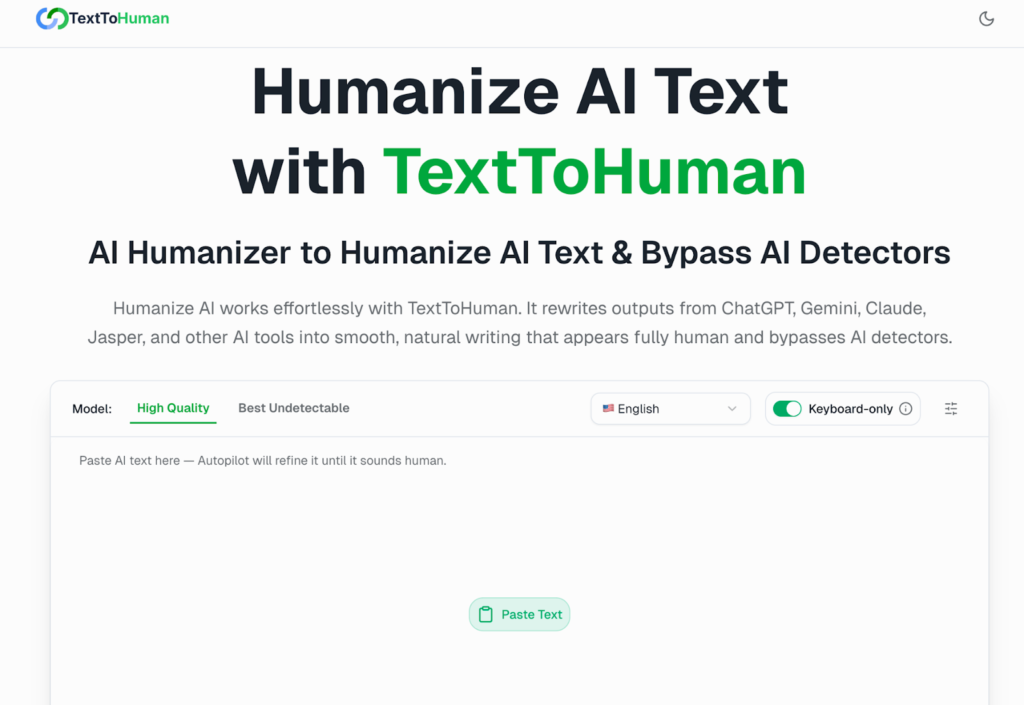
  • Sesame AI Review: Most Human-Like Voice Companion

    Sesame AI Review: Most Human-Like Voice Companion

    If you’ve ever wished for an AI assistant that doesn’t sound like a robot reading a script, Sesame AI might be exactly what you’re looking for. After spending considerable time testing this conversational voice platform, I’m sharing everything you need to know about whether it lives up to the hype.

    What is Sesame AI?

    Sesame AI is an interdisciplinary product and research platform developed by Sesame, a team focused on creating voice companions that integrate seamlessly into daily life. Unlike traditional text-based chatbots, Sesame specializes in natural, expressive voice interactions through its two AI companions: Maya and Miles.

    The platform’s core innovation lies in what the team calls “voice presence” — a combination of emotional intelligence, natural conversation flow, and contextual awareness that aims to cross the uncanny valley of conversational AI. This means interactions feel less like talking to a machine and more like having a conversation with someone who actually understands context and emotional nuance.

    Key Features That Set Sesame AI Apart

    1. Conversational Speech Model (CSM)

    Sesame uses a proprietary Conversational Speech Model that adapts to context in real-time. The system doesn’t just respond to your words; it picks up on conversational cues, tone, and flow to create genuinely interactive dialogue.

    2. Dual AI Personalities

    Users can choose between:

    • Maya: Known for her warm, supportive conversation style
    • Miles: Offers a different conversational approach

    Both personalities maintain consistent character traits while adapting to your specific needs and conversation style.

    3. Extended Conversation Sessions

    Free users get 5-minute demo sessions, while logged-in users can enjoy 30-minute conversations. This extended duration allows for more meaningful interactions compared to quick query-response exchanges.

    4. Cross-Platform Availability

    Sesame AI is accessible via:

    • Web application (app.sesame.com)
    • Google Play Store (Android)
    • Apple App Store (iOS)

    This multi-platform approach ensures you can maintain continuity across devices.

    Real-World Use Cases: Where Sesame AI Excels

    Based on actual user experiences and testing, here’s where Sesame AI proves most valuable:

    Language Learning and Practice

    Users have specifically praised Maya as an AI English tutor. The natural conversation flow makes it excellent for:

    • Practicing conversational English
    • Improving pronunciation through natural dialogue
    • Building confidence in speaking skills
    • Learning colloquial expressions in context

    Personal Support and Companionship

    Sesame positions itself as a companion rather than just a tool. Similar to other AI virtual companions, it’s particularly useful for:

    • Processing complex emotions and situations
    • Brainstorming ideas without judgment
    • Having someone to talk to during lonely moments
    • Navigating work or school challenges

    Productivity and Wellness

    The AI companions can assist with:

    • Fitness motivation and workout planning
    • Reading goal accountability
    • Daily task organization
    • Mental wellness check-ins

    Creative Collaboration

    Users report success using Sesame for:

    • Brainstorming creative projects
    • Talking through writing ideas
    • Getting feedback on concepts
    • Exploring different perspectives

    How Sesame AI Compares to Other Platforms

    Sesame AI vs. ChatGPT

    While ChatGPT excels at text-based information retrieval and task completion, Sesame AI focuses on conversational depth. For a detailed comparison of different AI writing tools, check out our ChatGPT vs Jasper AI comparison. ChatGPT is better for research, coding, and complex problem-solving, whereas Sesame shines in emotional intelligence and natural dialogue flow.

    Sesame AI vs. Other Voice AI Platforms

    If you’re comparing voice AI options, you might also want to explore ElevenLabs AI, which specializes in voice generation and cloning. However, ElevenLabs focuses more on creating synthetic voices for content creation, while Sesame is built specifically for conversational interaction.

    Sesame AI vs. Character Chat Platforms

    For users interested in AI character interactions, platforms like Janitor AI, Sakura AI, and Joyland AI offer text-based character chat experiences. Sesame differentiates itself with voice-first interaction and a focus on realistic human-like conversation rather than roleplay scenarios.

    Sesame AI vs. Traditional Voice Assistants

    Unlike Alexa, Siri, or Google Assistant (which are command-based), Sesame AI engages in actual conversations. Traditional assistants execute tasks; Sesame builds rapport and maintains conversational context throughout extended interactions.

    User Experience: What People Are Actually Saying

    According to reviews and user feedback across platforms:

    What Users Love:

    • “The most human-like AI voice I’ve encountered” is a common sentiment
    • Natural conversation flow that doesn’t feel scripted
    • Emotional intelligence in responses
    • Consistency in personality and memory across sessions
    • Low latency in responses

    Areas for Improvement:

    • Some users note a remaining gap in conversational prosody (the rhythm and intonation of speech)
    • Limited free session time (5 minutes for demos)
    • Feature set still expanding compared to more established platforms

    One ZDNET reviewer noted: “This is the closest to a human experience I’ve ever had talking to an AI, and the only chatbot that I feel like I wouldn’t mind talking to again.”

    Technical Innovation: Crossing the Uncanny Valley

    Sesame’s research team has published findings on their approach to achieving natural voice presence. Their Conversational Speech Model addresses several common problems in AI voice technology:

    Contextual Adaptation: The system adjusts tone, pace, and response style based on conversation context rather than using fixed patterns.

    Emotional Recognition: Maya and Miles can pick up on emotional cues in your voice and adjust their responses accordingly.

    Natural Pausing and Pacing: Unlike many AI voices that sound rushed or awkwardly timed, Sesame’s voices incorporate natural speech patterns including appropriate pauses and conversational rhythm.

    Getting Started with Sesame AI

    Free Demo Access

    1. Visit sesame.com or app.sesame.com
    2. Choose between Maya or Miles
    3. Start a 5-minute demo session without login
    4. No credit card required for initial trial

    Extended Access

    1. Create an account (sign up with Google is available)
    2. Unlock 30-minute conversation sessions
    3. Get early access to upcoming features
    4. Maintain conversation history and preferences

    Mobile App Experience

    Download from Google Play or Apple App Store for:

    • On-the-go access to your AI companion
    • Push notifications for reminders (if enabled)
    • Seamless device switching
    • Offline capability (limited features)

    Who Should Use Sesame AI?

    Ideal Users:

    • Language learners seeking conversational practice
    • People who feel more comfortable processing thoughts verbally
    • Remote workers or students needing accountability partners
    • Anyone experiencing loneliness or isolation
    • Creative professionals who benefit from talking through ideas
    • Individuals working on emotional intelligence or communication skills

    May Not Be Ideal For:

    • Users needing extensive factual research (better served by ChatGPT or Perplexity)
    • Those requiring specific task automation
    • Users who prefer text-based interaction
    • People seeking completely free, unlimited access

    Privacy and Data Considerations

    By using Sesame AI, you agree to their Terms of Use and Privacy Policy. Key considerations:

    • Conversations are processed to improve AI performance
    • Voice data is used to enhance the Conversational Speech Model
    • Account information is collected when you create a login
    • Review their privacy policy at sesame.com for complete details

    As with any AI platform handling voice data, consider what information you share during conversations.

    Pricing Structure

    While specific pricing tiers weren’t explicitly detailed in available information:

    Free Tier:

    • 5-minute demo sessions
    • Access to both Maya and Miles
    • Basic conversational features

    Logged-in Users:

    • 30-minute sessions
    • Early access to new features
    • Conversation continuity

    For current pricing and premium options, visit sesame.com directly as offerings may expand.

    Alternative AI Companions to Consider

    If you’re exploring different AI companion options, here are some alternatives worth checking out:

    The Future of Conversational AI: Sesame’s Vision

    Sesame’s research focus suggests they’re working toward:

    • Further reducing gaps in conversational prosody
    • Expanding contextual understanding
    • Adding more specialized use cases
    • Improving multi-turn conversation memory
    • Enhancing emotional intelligence capabilities

    The team’s commitment to crossing the uncanny valley indicates ongoing improvements to make voice interactions even more natural.

    Final Verdict: Is Sesame AI Worth Trying?

    Strengths:

    • Industry-leading natural voice quality
    • Genuine conversational ability beyond simple queries
    • Emotional intelligence in interactions
    • Free demo available without commitment
    • Multi-platform accessibility

    Limitations:

    • Still developing compared to established text AI platforms
    • Free tier is quite limited (5 minutes)
    • Some prosody gaps remain in conversational flow
    • Feature set continues expanding

    Bottom Line: Sesame AI represents a significant leap forward in conversational AI voice technology. If you value natural dialogue, emotional support, or voice-based interaction over text, it’s absolutely worth trying the free demo. The platform won’t replace comprehensive research tools like ChatGPT, but for companionship, language practice, and talking through ideas, it offers something genuinely unique.

    The 5-minute free demo provides enough time to experience whether the conversational style resonates with you. For users who connect with Maya or Miles, the 30-minute sessions available to logged-in users offer substantial value.

    Getting the Most from Your Sesame AI Experience

    Tips for Better Conversations:

    1. Treat it like a real conversation: Rather than issuing commands, engage naturally as you would with a friend or colleague.
    2. Use it for specific purposes: Whether language practice, brainstorming, or emotional processing, having clear use cases helps you leverage the platform’s strengths.
    3. Be patient with responses: While latency is low, allowing natural conversation pace creates better interactions than rushing through queries.
    4. Try both Maya and Miles: Different users connect better with different conversation styles. Experiment with both AI companions.
    5. Provide feedback: The platform is actively developing, and user feedback helps shape improvements.

    Optimizing Your Voice AI Strategy

    If you’re integrating AI tools into your workflow, consider exploring our comprehensive guide on best AI automation tools to see how voice AI fits into a broader productivity strategy. For those working with AI-generated content, our guide on humanizing AI text can help ensure your outputs feel natural and authentic.


    Frequently Asked Questions

    Is Sesame AI completely free?

    Sesame AI offers a free 5-minute demo without requiring login. Extended 30-minute sessions require account creation, though specific pricing for premium features should be confirmed on their website.

    Can Sesame AI replace therapy or professional support?

    No. While Sesame AI can provide companionship and help process thoughts, it’s not a substitute for professional mental health support or medical advice.

    How does Sesame AI handle multiple languages?

    Based on available information, Sesame AI primarily focuses on English conversations, though specific multi-language support details should be confirmed directly with the platform.

    Does Sesame AI remember past conversations?

    Logged-in users benefit from conversation continuity and context retention across sessions, though specific memory capabilities continue to evolve.

    Is my conversation data private?

    Sesame AI collects and processes conversation data according to their Privacy Policy. Review their terms at sesame.com for complete information on data handling.

  • Top Logo Makers 2025: Best Free & AI Tools Reviewed

    Top Logo Makers 2025: Best Free & AI Tools Reviewed

    Creating a professional logo no longer requires hiring expensive designers or mastering complex software. Modern logo makers have democratized brand identity creation, offering powerful tools that anyone can use regardless of design experience.

    The logo maker landscape has evolved dramatically with artificial intelligence transforming how businesses approach visual branding. From completely free platforms to AI-powered generators that create custom designs in seconds, today’s tools cater to every budget and skill level.

    Choosing the right logo maker depends on your specific needs, technical comfort level, and budget constraints. Some platforms excel at speed and simplicity while others offer deep customization capabilities for users who want complete creative control.

    This comprehensive guide examines the top logo makers available in 2025, helping you identify which tool best matches your brand identity goals and resource availability.

    Best Free Logo Maker Options

    Free logo makers provide surprising functionality without requiring upfront investment. These platforms allow startups and small businesses to establish professional visual identities while conserving limited budgets.

    Canva stands out as the most versatile free logo maker available today. The platform offers extensive template libraries, intuitive drag-and-drop functionality, and professional design elements accessible to complete beginners.

    Canva logo maker strengths:

    • Over 250,000 customizable logo templates spanning every industry
    • User-friendly interface requiring zero design experience
    • Free access to millions of stock photos and graphics
    • Ability to create matching brand materials like business cards
    • Cloud-based platform accessible from any device
    • Collaborative features for team-based design work

    The free version provides substantial capabilities though premium elements require paid subscriptions. Most users find the free tier sufficient for creating professional-looking logos.

    DesignEvo offers another compelling free option focused specifically on logo creation. The platform prioritizes simplicity and speed over extensive feature sets.

    DesignEvo key features:

    • 10,000+ professionally designed templates
    • Quick customization with fonts, colors, and icons
    • No design skills required for basic logo creation
    • Free downloads available in lower resolutions
    • Simple three-step creation process
    • Category-based template organization

    FreeLogoDesign provides completely free logo downloads at standard resolution. The platform generates logo options based on your company name and industry selection.

    Limitations exist across all free platforms. Resolution restrictions, watermarks on certain export formats, and limited commercial usage rights represent common constraints. Reading terms of service carefully prevents future complications.

    AI Logo Generator Revolution

    Artificial intelligence has transformed logo creation from manual design to intelligent generation. AI logo makers analyze your inputs and brand preferences to create custom designs matching your specifications.

    Looka leads the AI logo generator category with sophisticated machine learning algorithms. The platform generates hundreds of logo variations based on your style preferences and industry.

    Looka AI capabilities:

    • Intelligent design suggestions based on brand personality
    • Real-time customization with instant preview
    • Color psychology integration for brand messaging
    • Font pairing recommendations
    • Multiple logo variations for different use cases
    • Brand kit generation with consistent styling

    The AI asks targeted questions about your aesthetic preferences, target audience, and brand values. This information feeds algorithms that generate logos reflecting your specific requirements.

    Brandmark takes AI logo creation further by offering comprehensive brand identity tools beyond basic logos. The platform uses neural networks to create cohesive visual systems.

    Brandmark advanced features:

    • AI-powered color palette generation
    • Automated social media asset creation
    • Business card design with logo integration
    • Font matching algorithms
    • Logo uniqueness verification
    • Resolution adjustment tools

    LogoAI specializes in creating complete brand identities through artificial intelligence. The platform generates logos alongside matching marketing materials and brand guidelines.

    AI generators work best when you provide clear direction about style preferences. Vague inputs produce generic results while specific guidance yields customized designs reflecting your brand personality.

    Canva Logo Maker Deep Dive

    Canva has become synonymous with accessible design tools. The logo maker represents just one component of this comprehensive creative platform.

    The interface welcomes beginners with familiar social media-style navigation. Templates categorize by industry, style, and use case, making relevant starting points easy to locate.

    Canva design process:

    Search for logo templates using keywords describing your industry or aesthetic. Browse through hundreds of professionally designed options.

    Select a template that resonates with your brand vision. All elements become immediately editable upon selection.

    Customize text by replacing placeholder company names with your business name. Font libraries offer thousands of typeface options.

    Adjust colors to match your brand palette. The color picker allows precise color matching using hex codes.

    Modify layout by dragging elements, resizing components, and experimenting with positioning. The grid system helps maintain visual balance.

    Add shapes, icons, or illustrations from Canva’s extensive library. Search functionality helps locate specific design elements quickly.

    The platform’s strength lies in versatility rather than logo-specific optimization. Users can create comprehensive brand materials within a single ecosystem, ensuring visual consistency across all marketing assets.

    Canva Pro unlocks advanced features including background remover, brand kit functionality, and premium design elements. The subscription costs significantly less than professional design services while offering substantially more creative control.

    Wix Logo Maker for Website Integration

    Wix Logo Maker serves businesses building websites on the Wix platform. The tool integrates seamlessly with Wix’s website builder, creating cohesive digital presences.

    The AI-driven approach asks questions about your business, style preferences, and intended logo usage. Algorithms generate customized logo options based on your responses.

    Wix Logo Maker process:

    Enter your business name and optional tagline. This text becomes the foundation of your logo design.

    Select your industry from predefined categories. Industry selection influences style recommendations and icon suggestions.

    Choose logo styles that appeal to your aesthetic sensibility. Options range from minimalist to elaborate designs.

    Review AI-generated logo concepts. The system creates multiple variations incorporating your preferences.

    Customize selected designs by adjusting fonts, colors, layouts, and icons. Real-time editing shows immediate results.

    Download final logos in various formats suitable for different applications. File types include PNG, JPG, and vector formats.

    The platform shines for Wix website owners who want visual consistency between their logo and site design. Standalone logo creation remains possible without Wix website commitment.

    Free logo downloads include standard resolution files. High-resolution and vector file access requires purchasing the logo package.

    Logo Maker AI Technology Comparison

    AI-powered logo makers vary significantly in sophistication and output quality. Understanding technological differences helps identify which platform will deliver results meeting your standards.

    Machine learning models powering these tools have different training approaches. Some systems analyze millions of existing logos to understand design principles. Others focus on color theory, typography rules, and composition guidelines.

    Key AI capabilities to evaluate:

    Learning algorithms that improve with user feedback. Better systems adapt recommendations based on your selections and rejections.

    Style transfer technology that applies aesthetic characteristics consistently. This ensures cohesive brand identity across logo variations.

    Icon generation that creates custom graphics rather than relying solely on template libraries. Original iconography differentiates your brand.

    Color palette generation using color theory and psychology. Intelligent systems suggest combinations reflecting brand personality.

    Typography matching that pairs complementary fonts. Professional-looking logos require harmonious typeface combinations.

    Layout optimization that balances visual elements automatically. Proper composition distinguishes amateur from professional designs.

    Looka’s AI demonstrates particular strength in style consistency and color psychology integration. The system generates cohesive brand identities rather than isolated logo designs.

    Brandmark’s neural networks excel at creating unique combinations of elements. The platform reduces likelihood of generic-looking logos that resemble competitor branding.

    LogoAI focuses on comprehensive brand building beyond logo creation. The AI generates entire visual systems including social media templates and marketing materials.

    Best Free Logo Maker for Small Business

    Small businesses face unique constraints balancing professional appearance with limited budgets. The best free logo makers for this audience combine quality output with zero cost barriers.

    Top free options for small business:

    Canva provides the most comprehensive free tier. Small businesses can create logos and all supporting marketing materials without spending money.

    Hatchful by Shopify offers completely free logo creation with unlimited downloads. The tool targets e-commerce businesses but works for any industry.

    GraphicSprings allows free logo design with paid downloads. Businesses can experiment extensively before committing financially.

    Namecheap Logo Maker provides free logo creation for domain customers. The platform works best for businesses already using Namecheap services.

    FreeLogoDesign delivers standard resolution downloads without charges. Quality suffices for digital usage though print applications may require higher resolution.

    Small business owners should prioritize platforms offering commercial usage rights in free tiers. Some “free” logo makers restrict business usage or require attribution in exchange for no-cost access.

    File format flexibility matters significantly. Vector files scale infinitely without quality loss, making them essential for businesses planning to use logos across varied applications from business cards to billboards.

    Brand kit functionality helps small businesses maintain visual consistency. Platforms that save color palettes, fonts, and design elements simplify creating cohesive marketing materials over time.

    Logo Maker App for Mobile Design

    Mobile logo maker apps enable design work from smartphones and tablets. These applications suit entrepreneurs and small business owners who work primarily from mobile devices, especially those looking to create an AI logo quickly without relying on desktop software.

    Adobe Express (formerly Adobe Spark) leads mobile logo creation with professional-grade tools optimized for touch interfaces. The app provides desktop-level functionality in mobile format.

    Adobe Express mobile advantages:

    • Professional templates designed for mobile editing
    • Seamless synchronization across devices
    • Integration with Adobe Creative Cloud
    • Animation capabilities for motion logos
    • Extensive font and graphic libraries
    • Intuitive touch-based editing controls

    Canva’s mobile app mirrors desktop functionality with excellent touch optimization. The mobile experience feels natural rather than like a compromised desktop version.

    Logo Maker Shop offers mobile-first design specifically for logo creation. The stripped-down interface prioritizes simplicity over extensive feature sets.

    Mobile logo maker considerations:

    Screen size limitations affect detail work. Fine adjustments become challenging on smaller displays.

    Export file formats may be limited compared to desktop versions. Vector file availability varies by application.

    Storage requirements can be substantial. High-quality templates and graphics consume significant device memory.

    Internet connectivity often necessary for full functionality. Cloud-based platforms require active connections.

    Touch controls sometimes lack precision of mouse input. Detailed positioning and sizing may frustrate users.

    Mobile apps work best for initial concept development and basic logo creation. Final refinements often benefit from desktop environment precision.

    Logo Maker Website Platforms Compared

    Web-based logo makers offer advantages over downloadable software including zero installation requirements and device flexibility. Platform capabilities vary dramatically across the competitive landscape.

    Logo.com provides one of the most streamlined experiences available. The platform generates logo options rapidly based on minimal user input.

    Logo.com workflow:

    Enter business name and industry. The system immediately generates hundreds of logo concepts.

    Filter results by style, symbol, and color preferences. Quick refinement narrows options to relevant designs.

    Select a logo for customization. Editing tools adjust every design element.

    Preview logos across applications including business cards, websites, and merchandise. Context helps evaluate logo effectiveness.

    Purchase and download final designs in multiple formats. Package includes various file types and sizes.

    Fiverr Logo Maker combines AI generation with designer-created elements. The hybrid approach balances automation with human creativity.

    BrandCrowd offers extensive template library with powerful search functionality. The platform excels at helping users find inspiration quickly.

    Tailor Brands focuses on comprehensive brand building beyond logo creation. The service generates complete visual identities including typography systems and color palettes.

    Top 10 Logo Maker Tools Ranked

    Ranking logo makers requires weighing multiple factors including ease of use, output quality, pricing, and feature comprehensiveness. This ranking reflects overall value across typical use cases.

    1. Design.com – Best Overall for Logos & AI Design

    Largest logo library in the world, the #1 AI logo generator integrated in a design platform and brand kit with 50+ design tools

    2. BrandCrowd – Best Quality Logos & Brand Kit

    Largest logo library in the world, the #1 AI logo generator with access to a powerful design platform with 40+ design tools

    3. Canva – Best Overall

    Unmatched versatility combining logo creation with complete design suite. Free tier provides substantial functionality while paid plans remain affordable.

    4. Looka – Best AI Logo Generator

    Sophisticated artificial intelligence creates professional, customized logos efficiently. Excellent for users wanting guidance through design process.

    5. Adobe Express – Best for Creative Professionals

    Professional-grade tools accessible to beginners. Integration with Adobe ecosystem benefits designers using multiple creative applications.

    6. Brandmark – Best for Complete Brand Identity

    Comprehensive brand building tools extend beyond basic logo creation. Neural network technology generates cohesive visual systems.

    7. Wix Logo Maker – Best for Website Owners

    Seamless integration with Wix platform creates unified web presence. Excellent for businesses building Wix websites simultaneously.

    8. DesignEvo – Best Simple Interface

    Streamlined creation process prioritizes speed over extensive features. Perfect for users wanting quick results without complexity.

    9. Hatchful – Best Free Option

    Completely free logo creation and unlimited downloads. Shopify integration benefits e-commerce businesses.

    10. Logo.com – Best for Quick Generation

    Rapid logo concept generation based on minimal input. Extensive variation options accommodate diverse preferences.

    11. Fiverr Logo Maker – Best Hybrid Approach

    Combines AI automation with designer-created elements. Balances speed of generation with human creative touch.

    12. LogoAI – Best for Comprehensive Marketing Assets

    Generates complete brand systems including marketing materials. Automated brand consistency across all business assets.

    Rankings reflect current capabilities as of 2025. Platform updates and new entrants continuously shift competitive dynamics.

    Logo Maker for Startups and Entrepreneurs

    Startups face unique branding challenges balancing professional appearance with extreme budget consciousness. The right logo maker helps early-stage companies establish credible brand identities without depleting limited resources.

    Speed matters critically for startups moving quickly to establish market presence. Logo makers offering rapid generation help entrepreneurs launch faster than traditional design timelines allow.

    Startup-specific considerations:

    Scalability for growing businesses. Logos must work across expanding applications as companies grow from concept to enterprise.

    Iteration flexibility as brand identity evolves. Early-stage companies often refine positioning requiring logo adjustments.

    Budget constraints demanding free or low-cost solutions. Bootstrapped startups cannot justify expensive design agencies.

    File format variety for diverse applications. Startups need logos working across digital platforms, print materials, and merchandise.

    Brand consistency tools for lean teams. Small teams benefit from automated brand guideline generation.

    Looka particularly suits startups with its AI-guided process and comprehensive brand kit output. The platform generates not just logos but entire visual identities including color palettes and typography systems.

    Canva’s free tier enables startups to create logos and all marketing materials within a single platform. This consolidation simplifies brand management for small teams juggling multiple responsibilities.

    Hatchful provides completely free professional logos specifically designed for e-commerce and online businesses. The Shopify connection benefits startups building online retail presence.

    Logo Design Website Professional Services

    DIY logo makers serve many businesses well but some situations demand professional designer expertise. Understanding when to graduate from automated tools to professional services prevents costly rebranding later.

    Signs you need professional logo design:

    Complex brand positioning requiring nuanced visual expression. Sophisticated brand strategies benefit from designer interpretation.

    Highly competitive markets where visual differentiation determines success. Professional designers create distinctive identities standing out from competition.

    Established businesses with existing brand equity. Redesigns for known brands require careful strategic thinking beyond automated generation.

    Legal or regulatory considerations in logo usage. Professional designers understand trademark issues and intellectual property concerns.

    Multi-platform requirements with extensive application variations. Complex deployment scenarios benefit from comprehensive design systems.

    Professional logo designers bring strategic thinking, market understanding, and technical expertise beyond algorithm capabilities. They research competitors, understand psychological impacts of design choices, and create adaptable identity systems.

    Platforms like Fiverr, Upwork, and 99designs connect businesses with freelance logo designers at various price points. Costs range from budget-friendly to premium depending on designer experience and project scope.

    Local design agencies offer comprehensive brand identity services including strategy, logo design, and complete visual system development. These services cost significantly more than automated tools but deliver strategic brand foundations.

    Top AI Logo Makers Technology Breakdown

    Artificial intelligence powering modern logo makers represents significant technological advancement. Understanding the underlying systems helps evaluate which platforms will deliver results meeting your quality standards.

    Machine learning models train on massive datasets of existing logos, design principles, and successful brand identities. These training approaches determine output quality and stylistic capabilities.

    AI technology components:

    Neural networks analyze visual patterns and design relationships. Deep learning identifies what makes logos effective and memorable.

    Natural language processing interprets user descriptions and preferences. Systems translate verbal brand descriptions into visual characteristics.

    Generative adversarial networks create original design elements. This technology produces unique graphics rather than recombining existing assets.

    Style transfer algorithms apply aesthetic characteristics consistently. Visual coherence across brand materials results from this capability.

    Color theory algorithms suggest harmonious palette combinations. Psychological impacts of colors inform intelligent recommendations.

    Typography matching systems pair complementary fonts. Trained models understand which typeface combinations create professional appearances.

    Looka’s AI demonstrates particular sophistication in interpreting brand personality descriptions. The system translates abstract concepts like “trustworthy” or “innovative” into specific visual characteristics.

    Brandmark uses neural networks to generate completely original iconography rather than selecting from template libraries. This approach reduces likelihood of similar logos appearing across different businesses.

    LogoAI’s machine learning focuses on comprehensive brand system generation. The algorithms ensure visual consistency across logos, social media graphics, and marketing materials.

    Top 5 Free Logo Makers Detailed Comparison

    Free logo makers vary significantly in capabilities, limitations, and output quality. This detailed comparison highlights specific strengths and constraints across top platforms.

    Design.com Free Tier:

    Strengths include 400,000+ logo templates, design quality, over 750+ fonts (including 500 exclusive to the platform), over 60,000 graphics (shapes, icons, illustrations) that can be used in logos.

    Also offers free AI logo editing available on free templates. You can use a long prompt to edit the vector graphic (icon) or text before downloading for free.

    Free logo templates can be downloaded high res (PNG, JPG) and vector (SVG, PDF, EPS) with no watermark or usage restrictions.

    Free business cards, websites, link in bio, digital business cards and other many other designs also available.

    Limitations on downloading premium logo templates, premium website and business cards, volume of logo and AI editing. Free brand kit is only partially functional, full access requires premium upgrade.

    Best for users who care about quality logo design and AI logo editing, and those that want the option to upgrade to a unique, premium logo and a full design platform and brand kit that includes things like websites and business cards.

    BrandCrowd Free Tier:

    Strengths include 350,000+ logo templates, design uniqueness, over 500+ fonts (many exclusive and unique) and over 50,000 vector shapes / graphics.

    Full AI logo editing features also available on free logo templates.

    Free logos can be downloaded high res raster and also vector file formats.

    Other free design templates and tools are available – including free business cards and websites.

    Limitations on premium templates, brand kit, number of AI edits and number logo design edits.

    Best for users who care about quality logo design.

    Canva Free Tier:

    Strengths include 250,000+ templates, 5GB cloud storage, unlimited design creation, and ability to create complete brand materials beyond logos.

    Limitations involve premium element restrictions, no brand kit functionality in free tier, and watermarks on some advanced features.

    Best for users needing versatile design platform beyond logo creation alone.

    Hatchful by Shopify:

    Strengths include completely free unlimited downloads, no watermarks, commercial usage rights included, and e-commerce optimization.

    Limitations involve less customization than comprehensive platforms, smaller template library, and Shopify ecosystem optimization.

    Best for e-commerce businesses and entrepreneurs needing quick professional logos without cost.

    DesignEvo:

    Strengths include 10,000+ templates, simple three-step process, no account required for basic creation, and intuitive interface.

    Limitations involve low-resolution free downloads, watermarks on free versions, and limited format options without payment.

    Best for users wanting extremely simple creation process with option to upgrade later.

    FreeLogoDesign:

    Strengths include truly free standard resolution downloads, no attribution requirements, commercial usage rights, and industry-specific templates.

    Limitations involve limited high-resolution access, fewer customization options than premium platforms, and smaller design element library.

    Best for businesses needing functional digital logos without print requirements.

    GraphicSprings:

    Strengths include extensive free creation and editing capabilities, large template selection, ability to save multiple concepts, and no time restrictions.

    Limitations involve paid downloads only, no free export options, and subscription requirement for vector files.

    Best for users wanting extensive design experimentation before committing to purchase.

    What is the Best Logo Maker for Your Needs

    Determining the optimal logo maker requires honest assessment of your specific requirements, constraints, and intended usage scenarios. No single platform serves every use case equally well.

    Decision factors to evaluate:

    Budget availability determines free versus paid platform viability. Businesses with zero design budget must prioritize platforms offering free downloads with commercial usage rights.

    Design experience level influences interface complexity tolerance. Complete beginners need intuitive tools while design-savvy users may want advanced customization capabilities.

    Time constraints affect platform selection. Users needing immediate results should choose AI generators while those with flexibility can explore template libraries extensively.

    Application diversity impacts file format requirements. Digital-only usage allows lower resolution while print applications demand vector formats.

    Brand complexity determines whether DIY tools suffice or professional services become necessary. Simple, straightforward brands work well with automated generation while complex positioning benefits from designer expertise.

    Technical comfort influences platform type preference. Cloud-based web applications suit users avoiding software downloads while mobile apps serve smartphone-primary users.

    Ongoing design needs beyond logo creation may justify comprehensive platforms. Businesses requiring regular marketing material creation benefit from versatile design suites.

    Create decision matrix listing must-have features, nice-to-have capabilities, and absolute deal-breakers. Score platforms against these criteria to identify optimal choices objectively rather than based on marketing claims.

    Best Free AI Logo Maker Platforms

    AI-powered logo generation previously required premium subscriptions but several platforms now offer artificial intelligence capabilities in free tiers. These options democratize advanced logo creation technology.

    Free AI logo maker options:

    Wix Logo Maker provides AI-driven logo generation without upfront costs. Free accounts can create and experiment with AI-generated designs though downloads require payment.

    Namecheap Logo Maker offers AI logo creation free for domain customers. The included service adds value to domain registration purchases.

    Zyro AI Logo Maker generates designs through artificial intelligence with free preview capabilities. The platform targets website builders using Zyro’s services.

    Designs.ai includes logo creation within broader AI design suite. Free trial period allows testing AI generation before subscription commitment.

    Limitations typically involve download restrictions rather than creation constraints. Free tiers let users generate and refine AI logos but require payment for final file access.

    This model allows extensive experimentation before financial commitment. Users can generate dozens of logo concepts, refine favorites, and only pay once they’ve identified their ideal design.

    Watermarks commonly appear on free downloads forcing paid upgrades for clean files. Understanding these restrictions before investing design time prevents frustration.

    Logo Maker Software vs Online Platforms

    Choosing between downloadable software and web-based platforms involves weighing offline access against automatic updates and cross-device flexibility.

    Desktop software advantages:

    Offline functionality enables logo creation without internet connectivity. Remote work or unstable connections favor downloaded applications.

    Faster performance from local processing power. Complex designs render more quickly without internet latency.

    Permanent ownership through one-time purchases. Software licenses avoid recurring subscription costs.

    Advanced features often surpass web-based tools. Professional software includes sophisticated capabilities.

    Web-based platform benefits:

    Zero installation requirements simplify getting started. Users begin designing immediately without downloads.

    Automatic updates provide newest features constantly. No manual software updates necessary.

    Cross-device accessibility enables work from any location. Cloud storage allows seamless device switching.

    Collaboration features facilitate team-based design work. Multiple users can edit and comment simultaneously.

    Lower cost barriers through subscription models. Monthly fees create accessibility versus large upfront software purchases.

    Most modern logo creators favor web-based approaches given connectivity ubiquity and cloud computing advantages. Desktop software remains relevant for professional designers working offline or requiring maximum processing power.

    Best Overall Logo Makers

    The top overall logo makers in the world are best-in-class in multiple ways – they offer market-leading AI logo generation tools, huge template libraries and choice, high-quality and unique designs, genuinely free logo download options and they are integrated with other design tools (such as websites, business cards) to provide you with a brand kit that matches your logo.

    Design.com stands out as the best overall logo maker in the world. Design.com is an AI design platform that offers the world’s #1 AI logo generator and logo maker, the world’s largest logo template library and over 50 other design tools.

    Design.com key strengths:

    • 400,000+ high-quality logo templates
    • Powerful AI logo generator 
    • Extended licenses (included exclusive licenses)
    • Free logo download options (with PNG, JPG, EPS, SVG and PDF)
    • AI design platform with over 50+ design tools and 1 million templates 
    • Brand kit including websites, business cards, social media

    BrandCrowd is a design and branding platform also offers one of the top logo makers in the market.

    BrandCrowd key strengths:

    • 350,000+ high-quality logo templates
    • AI logo generator 
    • Extended licenses (included exclusive licenses)
    • Free logo download options (with PNG, JPG, EPS, SVG and PDF)
    • Extensive design platform with 40+ design tools
    • Brand kit including websites, business cards, social media

    Conclusion

    The logo maker landscape offers unprecedented options for businesses seeking professional visual identities without professional designer costs. From completely free platforms to sophisticated AI generators, tools exist for every budget and skill level.

    Canva leads the versatile design platform category providing comprehensive capabilities beyond logo creation alone. The free tier delivers substantial value while paid subscriptions unlock professional-grade features.

    Looka dominates AI-powered logo generation through sophisticated machine learning creating customized, professional designs efficiently. The platform suits users wanting guided design processes producing high-quality results.

    Free options like Hatchful enable startups and bootstrapped businesses to establish credible brand identities without financial investment. These tools prove that limited budgets need not result in amateur-looking logos.

    Choosing the right logo maker requires honest assessment of your design experience, budget constraints, application requirements, and time availability. No single platform optimally serves every use case.

    Start by identifying must-have features and absolute constraints. Test multiple platforms using free trials or creation tiers before committing to paid subscriptions. Most services allow extensive experimentation before requiring payment.

    Your logo represents your business visually to the world. Investing adequate time in creation process, even when using automated tools, ensures results that professionally represent your brand for years to come.

    The democratization of logo design through modern makers empowers businesses to establish professional brand identities previously accessible only through expensive agencies. Taking advantage of these tools levels the competitive playing field for companies of all sizes.