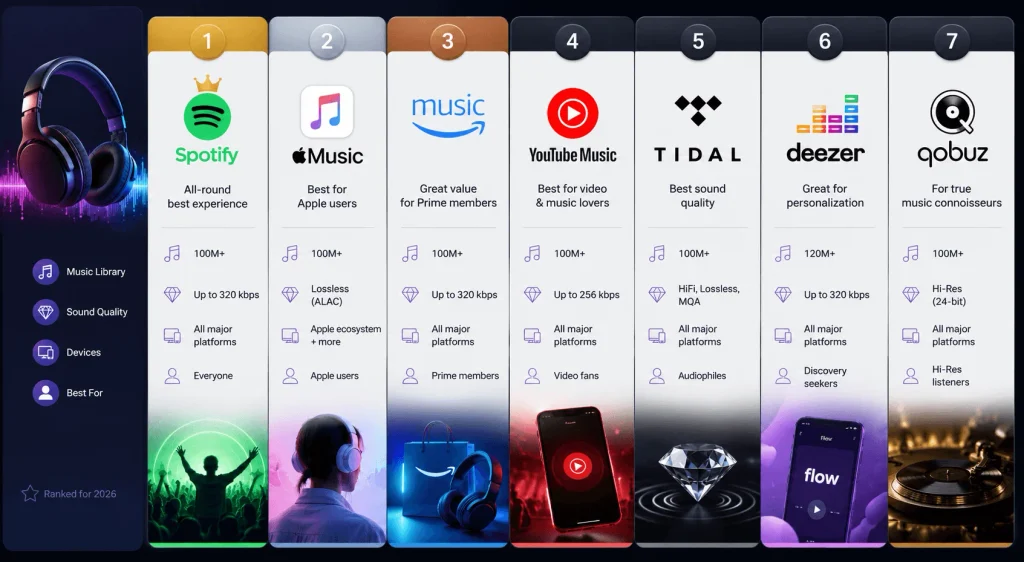
The best music streaming service in 2026 depends on four things: audio quality, discovery, price, and which ecosystem you’re already living in. Spotify wins on discovery and reach. Apple Music wins on sound quality if you’re in the Apple ecosystem. Tidal and Qobuz are the audiophile picks. Deezer offers the broadest catalog with a free tier. YouTube Music is essentially free if you’re already paying for YouTube Premium. Every major platform now carries 100 million or more songs, so catalog size stopped being the deciding factor years ago, and the real comparison happens on sound, price, and how well each app fits your habits.
Below, I’ll break down each platform, show you a side-by-side table, and give you a simple decision path so you can pick in under two minutes.
Why Your Music Streaming Choice Actually Matters
Your streaming platform choice locks in more than just a monthly bill, it locks in your playlists, your listening history, and a recommendation engine that’s been learning your taste for months or years. Switching later means rebuilding that from scratch.
The stakes are higher than they used to be because the market itself has exploded. The global music streaming market was valued at roughly $54.1 billion in 2025, with projections putting it near $158 billion by 2033. That level of competition is exactly why platforms keep adding lossless tiers, AI-curated playlists, and spatial audio: they’re fighting to keep you from switching.
Spotify alone crossed 300 million paid subscribers in Q2 2026, its first quarter ever above that mark, with 777 million monthly active users total. That scale explains why its recommendation engine feels so sharp: more listeners means more data means better predictions.
What to Compare Before You Pick a Streaming Service
Six factors separate a good choice from a subscription you’ll regret in six months.
- Audio quality — lossless, hi-res, and spatial audio support
- Discovery — how good the recommendation engine actually is
- Catalog and exclusives — podcasts, videos, live sessions
- Device and ecosystem fit — how well it plays with what you already own
- Pricing — individual, family, and student tiers
- Artist compensation — how the platform pays the people making the music
For a closer look at one specific platform’s strengths and trade-offs, see our full MusicHQ streaming service review
Quick Comparison Table: Best Music Streaming Services in 2026
| Service | Best For | Max Audio Quality | Starting Price | Free Tier |
|---|---|---|---|---|
| Spotify | Discovery & compatibility | Lossless, 24-bit/44.1kHz | ~$12.99/mo | ✅ |
| Apple Music | Sound quality & Apple ecosystem | Hi-Res Lossless, 24-bit/192kHz + Dolby Atmos | ~$10.99/mo | ❌ |
| Tidal | Audiophiles with hi-fi gear | Hi-Res FLAC, 24-bit/192kHz + Dolby Atmos | $11.99/mo | ❌ |
| Qobuz | Audiophile purists | Hi-Res FLAC, 24-bit/192kHz (Sublime tier) | ~$12.99/mo | ❌ |
| Deezer | Broad catalog & flexibility | CD-quality FLAC, 16-bit/44.1kHz | $11.99/mo | ✅ |
| YouTube Music | YouTube Premium bundlers | Standard/high quality | ~$10.99/mo | ✅ |
| Amazon Music Unlimited | Prime members | Ultra HD (lossless/hi-res) | ~$9.99/mo (Prime) | Limited |
Spotify: Best for Discovery and Compatibility
Spotify is the safest all-around pick for most listeners because of its recommendation algorithm and the sheer breadth of devices it runs on.
Discovery and Catalog
Consumer Reports specifically called out Spotify’s recommendation algorithm as a particular strength, paired with a library of 80 million songs and 4 million podcast titles organized into playlists. If you’re curious how Spotify’s discovery engine compares to newer AI-driven music discovery tools, our Spotalike review breaks down features, pricing, and alternatives worth considering.
Audio Quality
Spotify’s lossless option tops out at 24-bit/44.1kHz, with no hi-res tier beyond that and no spatial audio support. If you own serious headphones or a dedicated DAC, that ceiling will eventually bother you.
Spotify’s key strengths:
- Best-in-class discovery algorithm (Discover Weekly, Release Radar)
- Widest device and platform support
- Generous ad-supported free tier
- Massive podcast library alongside music
Apple Music: Best for Sound Quality
Apple Music offers the strongest overall audio experience on the market, and it doesn’t charge extra for it.
Audio Quality
Apple Music includes 24-bit Lossless (24-bit/48kHz) and Hi-Res Lossless up to 24-bit/192kHz, plus Dolby Atmos Spatial Audio, all in the standard subscription with no add-on tier. Reviewers at What Hi-Fi? found Apple’s ALAC lossless streams matched Tidal for openness and subtlety, sometimes sounding even cleaner than Spotify’s standard 320kbps streams.
Ecosystem and Curation
Apple Music pairs that audio quality with human-curated editorial playlists and deep integration across iOS, macOS, and CarPlay.
Apple Music’s key strengths:
- Hi-Res Lossless and Dolby Atmos at no extra cost
- Human-curated editorial playlists
- Clean, music-first interface
- Deep integration with iOS, macOS, and CarPlay
The trade-off is discovery, which is solid but generally considered a step behind Spotify’s, and there’s no free ad-supported tier to test the waters.
Tidal: Best for Audiophiles
Tidal is built specifically around sound quality, and it doesn’t gate hi-res behind a premium upsell.
Audio Quality and Pricing
Tidal streams lossless FLAC, Hi-Res FLAC up to 24-bit/192kHz, and Dolby Atmos, all included in a single standard plan. Pricing rose from $10.99 to $11.99 per month as of August 3, 2026, the increase Tidal had previously announced.
Getting the full benefit of Tidal’s Hi-Res FLAC and Dolby Atmos catalog depends heavily on your hardware. Check our Sony WH-1000XM6 guide if you’re shopping for headphones capable of resolving that extra detail.
Artist Payouts
Tidal markets itself around fairer artist compensation, using a payout model tied more directly to individual listening habits rather than pure aggregation.
Tidal’s key strengths:
- Full hi-res catalog with no premium audio tier
- Dolby Atmos spatial audio included standard
- Direct artist-payment initiatives
- No ad-supported free tier as of April 2024
Qobuz: Best for Audiophile Purists
Qobuz targets the same hi-fi audience as Tidal, but skips spatial audio in favor of native studio-grade FLAC.
Audio Quality
Qobuz streams native FLAC without MQA encoding, offering Hi-Res FLAC up to 24-bit/192kHz on its Studio plan, with a Sublime tier at $14.99/month pushing even further into premium territory. Its editorial content leans toward classical, jazz, and world music, and Qobuz pays the highest per-stream rate of any major service.
Qobuz’s key strengths:
- Native FLAC, no lossy compromise
- Highest reported per-stream artist payout
- Strong classical, jazz, and world music curation
- No podcasts and limited country availability
Deezer: Best for Catalog Breadth and Flexibility
Deezer competes less on peak audio quality and more on breadth, offering a bigger catalog, a free tier, and stronger algorithmic discovery than its hi-fi rivals.
Catalog and Discovery
Deezer offers over 120 million tracks with lossless FLAC audio and a strong presence in European, African, and Latin American markets, backed by Flow, its personalized radio feature, and SongCatcher for song identification.
Audio Quality vs. Tidal
Deezer caps out at CD-quality 16-bit/44.1kHz FLAC with no Dolby Atmos support, a step below Tidal and Qobuz, but Deezer counters with an ad-supported free tier that Tidal eliminated in 2024, plus a cheaper effective annual rate around $8.99/month.
Deezer’s key strengths:
- 120 million-track catalog
- Ad-supported free tier
- Strong international presence and localized curation
- CD-quality lossless included in the standard tier
YouTube Music: Best If You Already Have YouTube Premium
YouTube Music doesn’t try to be the flashiest option, it just does everything reasonably well for a specific group of listeners.
If you’re already paying for YouTube Premium, YouTube Music comes bundled at no additional cost. Where it struggles is audio quality, which falls short of the standards set by Tidal and Apple Music, and its approach to AI-generated content and artist compensation has drawn some criticism.
YouTube Music’s key strengths:
- Free if bundled with YouTube Premium
- Huge library of live performances, remixes, and music videos
- Low-friction, casual listening experience
Amazon Music Unlimited: Best Value for Prime Members
Amazon Music Unlimited is the quiet value pick for existing Amazon Prime subscribers. The discounted Prime pricing makes it one of the cheapest paths to a lossless catalog, and Amazon has built out Ultra HD hi-res streaming to compete on paper with Tidal and Apple Music.
It won’t win on discovery or interface polish, but if you’re already deep into the Amazon ecosystem through Echo devices and Prime, the switching friction is close to zero.
How to Choose the Right Streaming Service for You
Run through this five-step path to land on your answer in under two minutes:
- Deep in the Apple ecosystem? Go with Apple Music.
- Own high-end audio gear and want the absolute best sound? Choose between Tidal and Qobuz based on whether you want Dolby Atmos (Tidal) or native studio FLAC and classical curation (Qobuz).
- Want the best discovery and don’t need hi-res audio? Go with Spotify.
- Want a big catalog plus a free tier without hi-fi pricing? Go with Deezer.
- Already paying for YouTube Premium or deep in Amazon Prime? Stick with the bundle you already have.
Most individual plans now cluster between $10.99 and $12.99 per month, so price alone shouldn’t decide this for you. The real question is which trade-off you’re willing to live with: Spotify trades peak audio for better discovery, Deezer trades peak audio for catalog breadth and a free tier, and Tidal or Qobuz trade a slightly weaker discovery engine for best-in-class sound.
Frequently Asked Questions
Which music streaming service has the best sound quality in 2026?
Apple Music, Tidal, and Qobuz are the top tier, all offering Hi-Res audio up to 24-bit/192kHz, with Tidal and Apple Music adding Dolby Atmos spatial audio. Spotify’s lossless tier caps out lower at 24-bit/44.1kHz, and Deezer caps out at CD-quality 16-bit/44.1kHz.
Is Spotify still the best overall music streaming service?
Spotify remains the top pick for most listeners because of its recommendation algorithm, free ad-supported tier, and device compatibility, even though its top-end audio quality trails Apple Music, Tidal, and Qobuz.
Is Deezer or Tidal the better choice in 2026?
Both charge close to the same price, but Tidal wins on pure audio quality with hi-res FLAC and Dolby Atmos, while Deezer wins on flexibility with a bigger catalog, a free tier, and a cheaper effective annual rate.
Do I need a hi-res streaming service if I don’t own expensive headphones?
Not really. The audio quality differences between Spotify, Apple Music, Tidal, and Qobuz are most noticeable on high-end headphones or a dedicated DAC, so casual listeners on standard earbuds likely won’t hear much difference.
How much do music streaming services cost in 2026?
Individual plans generally range from $10.99 to $12.99 per month: Tidal and Deezer at $11.99, Apple Music around $10.99, Qobuz around $12.99 on its Studio plan, and Spotify around $12.99.
The Bottom Line
There’s no single universal winner, and anyone telling you otherwise is oversimplifying. Spotify is the safe, broad pick for most people. Apple Music is the smartest choice if you want the best sound without paying extra for it. Tidal and Qobuz are for listeners chasing every last bit of detail in a track. Deezer is the flexible middle ground with a free tier. Pick based on what you already own and what you actually care about hearing.
Leave a Reply