Most founders translate their landing page once, feel good about the checkmark, and never look at it again. Then six months later they’re wondering why signups from Germany or Brazil convert at a third of the US rate, even though the traffic is there and the pricing works.
The traffic isn’t the problem. The copy nobody re-checked is. CSA Research’s often-cited “Can’t Read, Won’t Buy” study found that 76% of consumers prefer to buy from a site written in their own language, but “translated” and “written well in that language” are not the same thing, and most tools never test the difference.
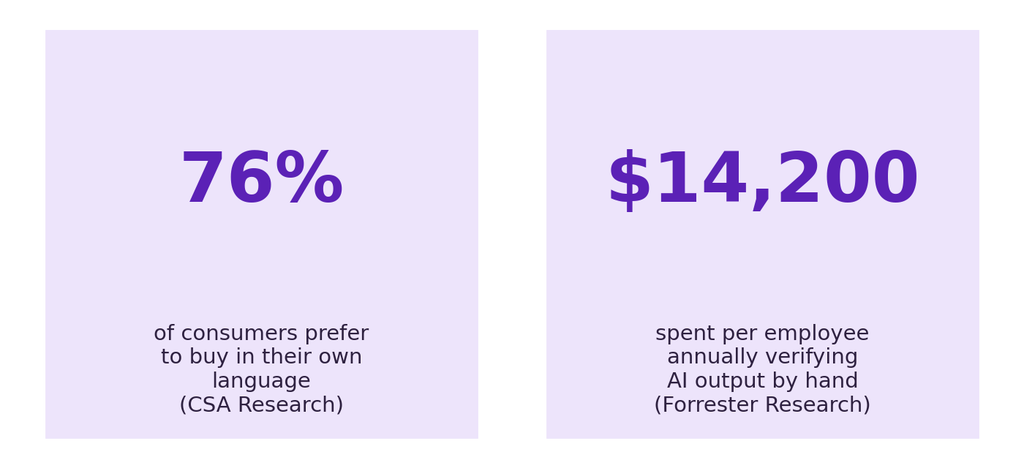
The two headline numbers behind this playbook: how much language preference matters, and what verifying AI output actually costs.
If you’re planning to scale into new markets this year, run this audit before you spend another dollar on international ads or directory placements. It takes an afternoon and it will tell you exactly where your translated copy is quietly costing you.
Step 1: Inventory Everything That’s Actually Translated
Start with a simple spreadsheet, not a tool. List every surface where a non-English user encounters your product: landing page, pricing page, onboarding emails, in-app tooltips, support macros, error messages, and your directory listings themselves (if you’re on AIListingTool or similar platforms, that listing copy counts too).
Most founders discover their “translated” product is actually about 40% translated. The homepage got attention. The password-reset email did not. Rank each surface by how many international users actually see it before they convert, and audit in that order.
Step 2: Test for Drift, Not Just Errors
Obvious mistakes, a broken sentence, a wrong word, are easy to spot. The bigger risk is subtler: terminology that shifts halfway through a page, a tone that reads formal in one section and casual in the next, or a call-to-action that’s grammatically correct but doesn’t actually persuade anyone in that language.
This is the same standard AIListingTool applies when it evaluates whether an AI tool review reflects real hands-on use rather than generic description, the specifics are what separate something trustworthy from something that just looks complete. Read your translated pages out loud, or better, have a native speaker who isn’t a professional translator read them cold. If they hesitate anywhere, that’s a flag.
Step 3: Understand Why One AI Model Isn’t Enough
Here’s the part most audits miss. If your translated copy came from a single AI model, ChatGPT, Google Translate, whatever was open in the tab, you’re not looking at a stable baseline. You’re looking at one model’s best guess on that particular day, and that guess isn’t consistent even across your own pages.
Internal testing at MachineTranslation.com, an AI translation platform that runs text through 22 models simultaneously and keeps whichever output the majority agree on, found that single AI models plateau at roughly 84–87% accuracy on major European languages like French, German, and Spanish, largely due to formatting slips and terminology drift across longer documents. That’s not a translation failure in the traditional sense. It’s a consistency failure, and it shows up exactly as tone drift and mismatched terminology across the different pages you just audited in Step 2.
The same check applies to specific terms too, not just whole pages. If you’re scaling into German-speaking markets, for example, it’s worth checking how to say “open source” in German before that term goes into your landing page or product copy.
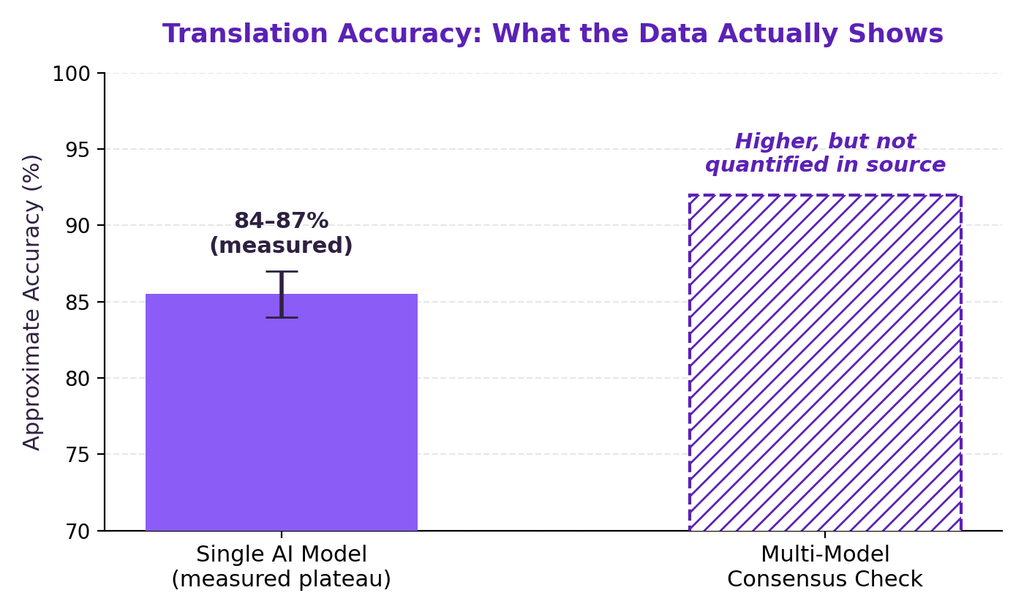
Only the single-model figure is a measured statistic from the source data; the multi-model comparison is directional, not independently quantified here.
The cost isn’t hypothetical, either. Forrester Research estimates enterprises already spend roughly $14,200 per employee annually just verifying AI-generated output by hand, a cost most small teams don’t budget for because it doesn’t show up as a line item, it shows up as an afternoon someone spends quietly rewriting a page nobody flagged as broken.
Step 4: Run a Panel Check Instead of a Single Pass
Once you know where the risk is, the fix isn’t “translate it better.” It’s checking your output against more than one source before you trust it. If you have the budget, run your highest-traffic pages through two or three different AI models and compare where they disagree, disagreement is the signal, not the noise. Where all the outputs converge, you can move fast. Where they diverge, that’s exactly where a human needs to look.
This is the same principle behind consensus-based translation systems generally: agreement across independent models is a much stronger accuracy signal than any single model’s confidence in its own answer. You don’t need to buy anything to apply the logic. You just need to stop trusting a single pass.
Step 5: Decide What Needs a Human
Not everything needs the same level of scrutiny. Your blog posts can tolerate more imperfection than your pricing page. Your pricing page can tolerate more imperfection than your terms of service. Build a simple three-tier system:
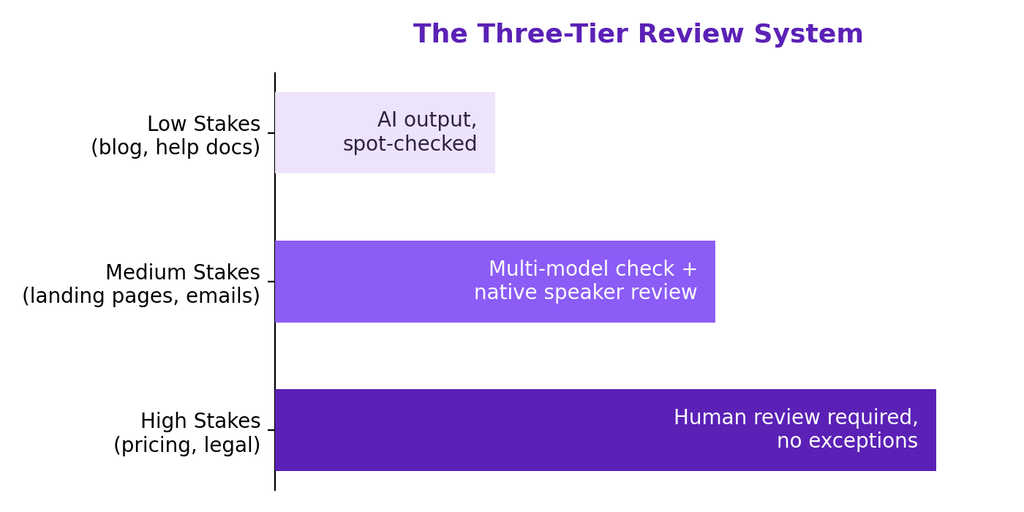
The three-tier review system from Step 5, matched to how much scrutiny each type of content actually needs.
The mistake most founders make is treating every page as low stakes because AI translation felt “good enough” the first time they checked it.
Step 6: Put It on Your Growth Calendar
An audit you run once and never repeat has a shelf life. AIListingTool’s own guidance on building topical authority recommends a quarterly content and internal-link audit for exactly this reason: quality drifts, new pages get added without the same scrutiny as the original launch, and small inconsistencies compound. Translated copy needs the same cadence. Every time you add a market, a pricing tier, or a major feature, that’s a trigger to re-run Steps 1 through 4, not a one-time task you check off before your first international user.
Before You Scale Further
None of this requires a localization team or a big budget. It requires treating your translated copy the way you’d treat any other part of your product that directly affects conversion: something you test, not something you assume works because it was translated once. If you’re already investing in distribution, directory listings, backlinks, international SEO, the copy underneath that traffic deserves the same attention. AIListingTool’s own SEO coverage for AI founders is a good place to keep learning how the rest of that distribution stack should hold up once the traffic actually arrives.
Leave a Reply